Scripture Focus: “Be sober, be vigilant; because your adversary the devil, as a roaring lion, walketh about, seeking whom he may devour.” — 1 Peter 5:8
Every now and then I stumble across something in God’s creation that quietly refuses to let go of my thoughts. It isn’t spectacular enough to make the evening news, and most people would probably read right past it. Yet somehow those ordinary little details often end up teaching extraordinary lessons—if we’re willing to stop long enough to notice.
That happened to me recently while reading about mallard ducks.
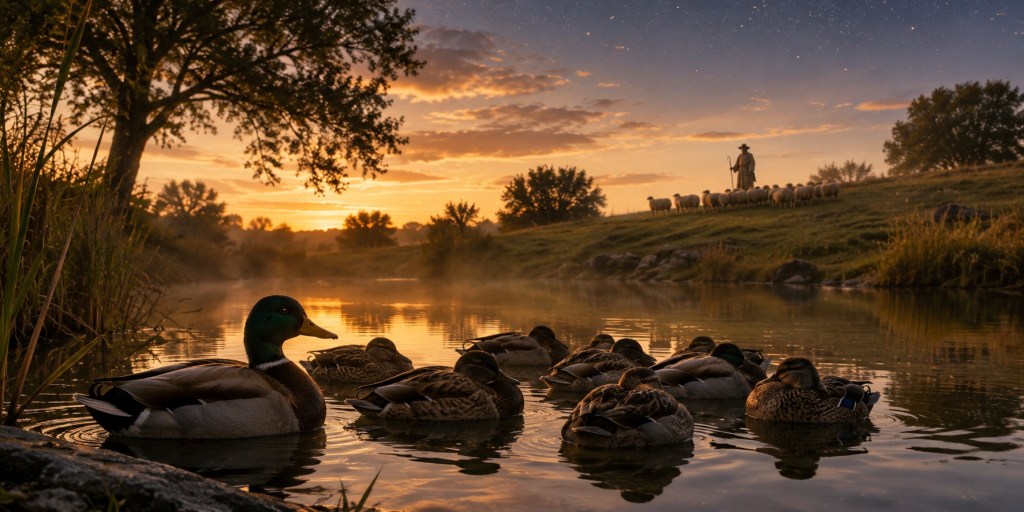
As evening settles over a quiet pond, a flock will often gather close together before drifting off to sleep. Those nestled safely in the middle relax completely, closing both eyes as they rest. But the ducks positioned along the outside edge frequently do something rather remarkable. They leave one eye open—the eye facing away from the flock. While the others sleep, they remain quietly aware of what lies beyond the circle.
Scientists explain it as a survival instinct. For me, it is another reminder of the wisdom the Creator has woven into His world.
The more I read, the more fascinated I became. Then I learned that giraffes, despite their towering size, often sleep only a few minutes at a time. Rising to their feet takes time and leaves them vulnerable, so they rest lightly, always aware that lions may be nearby. Different creatures. Different designs. Yet the same principle is woven into both. The more I thought about it, the more I began to see that creation understands the world it lives in.
Birds migrate before the seasons change. Squirrels gather food before winter arrives. Sheep remain near the shepherd. Ducks on the edge of the flock keep watch while the others sleep. Creation does not argue with the way God designed it to live. Each creature responds to the realities of its world with the instincts and boundaries its Creator has given it.
It made me wonder whether we always do the same.
Perhaps that is why Peter’s words came so readily to mind:
“Be sober, be vigilant; because your adversary the devil, as a roaring lion, walketh about, seeking whom he may devour.”
As I sat with Peter’s words, I realized I was no longer thinking merely about ducks or giraffes. I was thinking about how easily we can forget the kind of world we live in.
Peter’s comparison is striking. Lions are patient hunters. They watch the herd, wait for distraction, and notice the animal that has wandered just a little farther away or grown comfortable enough to stop paying attention. Their greatest advantage is often not their strength, but their timing.
Most believers do not wake up one morning determined to abandon Christ. Spiritual decline usually happens discreetly. It often begins when yesterday’s communion with God quietly substitutes for today’s. We become familiar with sacred things. Prayer becomes hurried. Scripture becomes something we intend to read rather than something we hunger to hear. Without realizing it, we begin depending upon spiritual memories instead of a present relationship with Christ.
Maybe that is why some of the saddest stories in Scripture begin during seasons that appeared perfectly ordinary. Adam and Eve were surrounded by perfection when the serpent approached. David was not standing in the heat of battle when temptation found him. Samson did not lose his strength in a single decision, but through compromises that slowly dulled his spiritual judgment. Peter sincerely believed he would never deny his Lord until the moment he did.
None of them imagined the destination when they took the first step. Small moments of neglect have a way of becoming larger moments of regret.
There is a profound difference between living in fear and living in dependence. Peter is not calling us to spend our lives nervously looking over our shoulder, giving the enemy more attention than he deserves. He is calling us to remain close to Christ, because sheep are safest near their Shepherd. Spiritual vigilance is not keeping one eye fixed on Satan; it is keeping both eyes on Jesus and refusing to wander beyond the sound of His voice.
Yet Peter’s warning is not the end of the story. Every duck eventually closes its open eye. Every giraffe finally lies down. And every one of us eventually turns out the lights, lays our head upon a pillow, and surrenders the day. We cannot remain awake forever, nor were we ever meant to.
That is where another passage of Scripture quietly meets Peter’s warning:
“Behold, he that keepeth Israel shall neither slumber nor sleep.” — Psalm 121:4
Every night, often without giving it much thought, we perform one of the simplest acts of faith imaginable. We close our eyes. We surrender the hours we cannot control, the questions we cannot answer, and the problems we could not solve before bedtime. We entrust ourselves to the care of a God we cannot see.
Tonight, somewhere along the edge of a quiet pond, a little duck will keep one eye open while the rest of the flock sleeps. Somewhere on the African plains, a giraffe will rest lightly, aware of dangers hidden in the darkness. Then I will do something neither of them can fully understand: I will close both of my eyes—not because the danger has disappeared or because tomorrow is guaranteed, but because the God who watches over His people never sleeps.
If this Fireside Chat warmed your spirit and sparked fresh resolve to live what you believe, fan that flame with Scripture—“Let the word of Christ dwell in you richly” (Colossians 3:16). Pull a little closer to the Light, and carry it into the week ahead.
👉 Sign up for the free FAST Crash Course in Bible Memorization: http://fast.st/cc/21419


Leave a comment