(Part 3 of a 3-Part Series)
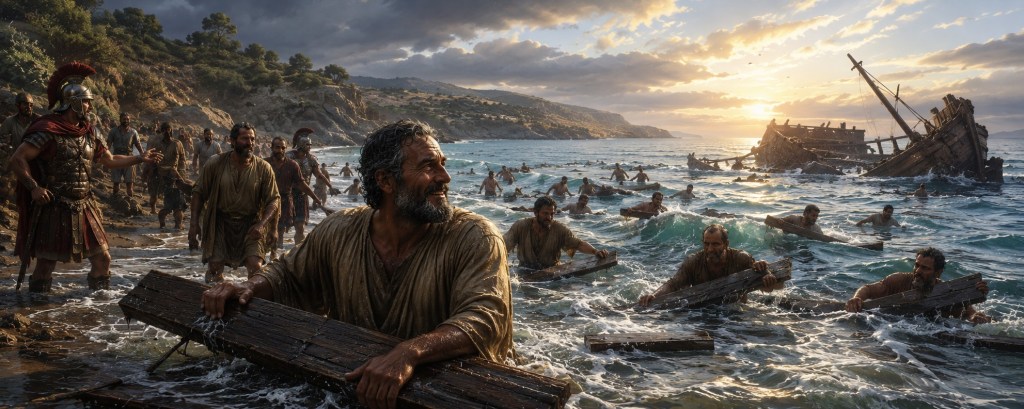
Scripture Focus: Acts 27:33-44
By the time daylight began to approach, the men aboard Paul’s ship had been fighting the storm for fourteen exhausting days. They had been driven across the sea without knowing where they were, unable to see the sun or stars, and uncertain whether the next wave would be the one that finally broke the ship apart. Fear had consumed so much of their attention that many had neglected even the most basic need of the body: food.
Paul understood that survival would require more than courage. They needed strength.
He urged everyone aboard to eat, reminding them that they had continued “fasting, having taken nothing” for fourteen days. Whether some had refused food because of seasickness, others because of terror, and still others because the constant labor left little opportunity, the result was the same. They were exhausted, frightened, and physically unprepared for what was still ahead.
Paul said, “Wherefore I pray you to take some meat: for this is for your health: for there shall not an hair fall from the head of any of you” (Acts 27:34). It was a remarkable assurance to give while the ship was still being tossed by the sea. The storm had not quieted, the shoreline was not yet visible, and no rescue vessel had appeared on the horizon. Yet Paul spoke of their survival as though it had already been settled.
Then, before all 276 people aboard, Paul took bread.
Luke writes that “he gave thanks to God in presence of them all: and when he had broken it, he began to eat” (Acts 27:35). That simple act must have seemed almost out of place amid the darkness, wet ropes, strained timbers, and crashing waves. Paul did not wait for calm seas before giving thanks. He thanked God while the ship was still in danger.
There is something deeply steadying about a person who can give thanks in the middle of uncertainty. Paul’s prayer did not deny the storm or pretend that the situation was less dangerous than it was. Gratitude was simply his declaration that the storm had not placed God beyond reach.
His confidence spread. Luke says, “Then were they all of good cheer, and they also took some meat” (Acts 27:36). The same people who had lost all hope now found enough courage to eat. Nothing outside them had changed yet, but something within them had. Hope had entered the ship through one man who believed God.
After they had eaten, the crew threw the remaining wheat into the sea to lighten the vessel. The cargo that had once been the reason for the voyage was now surrendered without hesitation. By this point, profit no longer mattered. Schedules no longer mattered. Even the ship itself had become expendable. The only remaining concern was reaching land alive.
When daylight finally came, the sailors saw an unfamiliar shoreline. They could not identify the land, but they noticed a bay with a beach and decided to attempt running the ship aground there. They cut the anchors loose, untied the rudder bands, raised the mainsail to the wind, and aimed the vessel toward shore.
For a moment, the plan appeared to work.
Then the ship struck a place where two currents met. The bow drove firmly into the sand or mud and became lodged so deeply that it could not move. Behind them, the force of the waves continued to pound against the stern until the vessel began to break apart.
After fourteen days of surviving the storm, the ship was finally being destroyed within sight of land.
There is a particular kind of frustration in coming close enough to see the shore and still watching everything fall apart. We tend to imagine that once God brings us near the answer, the final steps should become easier. Surely the last stretch ought to be smooth. Surely after enduring the wind, darkness, hunger, and fear, they had earned a gentle arrival.
Instead, the ship broke to pieces.
The soldiers immediately faced another danger. If the prisoners escaped during the confusion, the guards could be held responsible for their loss. Fearing that some might swim away, the soldiers decided to kill them before they could flee.
Once again, Paul’s life was threatened—not by the storm this time, but by the men who had survived it with him.
Julius intervened. The centurion who had initially trusted the shipmaster more than Paul had now seen enough to understand that this prisoner was unlike any man he had guarded before. Luke tells us that Julius, “willing to save Paul, kept them from their purpose” (Acts 27:43). He ordered those who could swim to enter the water first and make their way toward land.
The rest followed however they could.
Some clung to boards. Others held tightly to broken pieces of the ship. The great vessel that had carried cargo, soldiers, sailors, travelers, and prisoners across the Mediterranean was now scattered across the waves, reduced to fragments large enough for desperate hands to grasp.
Luke ends the chapter with one of the quietest and most triumphant sentences in the entire account: “And so it came to pass, that they escaped all safe to land” (Acts 27:44).
Every one of them.
All 276 people who had boarded the ship were alive. Not one had been lost to the wind, the waves, the darkness, the hunger, the soldiers’ swords, or the destruction of the vessel. The ship was gone, but the promise had reached shore.
One detail in that final scene has stayed with me: many of them arrived on broken pieces of the very ship they had trusted to carry them safely.
I find that wonderfully unexpected. No passenger had planned to approach the beach clinging to a splintered plank like an oversized pool float. They had expected the ship to deliver them intact. Instead, the thing that had fallen apart beneath them became the means God used to carry them the final distance.
Sometimes we are so busy mourning the wreck that we do not recognize what God is doing with the pieces.
We look at a broken plan, a closed chapter, a painful disappointment, or a future that no longer resembles the one we imagined, and assume it has become useless. We prayed for God to preserve the whole structure, but He may already be using part of what remains to keep us from going under.
That does not make the breaking painless. A plank is not a ship, and survival is not the same as pretending nothing was lost. God does not ask us to call destruction pleasant or disappointment insignificant. He simply reminds us that brokenness does not place us beyond His ability to save.
Paul had understood this before anyone reached the shore. God had promised that the people would survive, but He had never promised that the ship would remain intact. The vessel could break, the cargo could disappear, and every carefully made plan could be swallowed by the sea without weakening a single word God had spoken.
I have found that we often pray, “Lord, save my plans,” while God may be answering, “I will save you instead.”
We want Him to preserve the ship because the ship feels familiar. It gives us something solid beneath our feet and allows us to imagine we know how the journey will end. Yet sometimes faith means releasing the vessel and trusting the promise. The form of God’s deliverance may not look anything like what we expected, but His faithfulness is not measured by the condition of the ship.
Some people swam. Some floated. Some arrived clinging to broken boards. But every one of them reached the shore.
The storm could destroy the vessel, but it could not drown the promise.
And sometimes the evidence that God has kept His word is not that nothing broke. It is that, after everything broke, He still brought us safely through.
If this Fireside Chat warmed your spirit and sparked fresh resolve to live what you believe, fan that flame with Scripture—“Let the word of Christ dwell in you richly” (Colossians 3:16). Pull a little closer to the Light, and carry it into the week ahead.
👉 Sign up for the free FAST Crash Course in Bible Memorization: http://fast.st/cc/21419


Leave a comment