(Part 2 of a 3-Part Series)
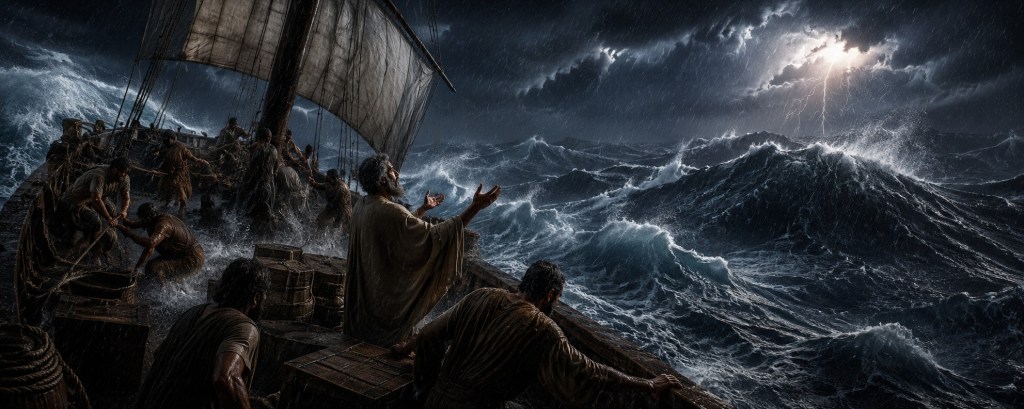
Scripture Focus: Acts 27:14–32
When we last saw Paul’s ship, it was moving away from Fair Havens beneath a gentle south wind. The sail had filled, the sea appeared cooperative, and the harbor they preferred seemed close enough to justify leaving the shelter they already had. To everyone aboard, the decision must have felt confirmed. The weather had finally turned in their favor.
Then Luke writes, “But not long after there arose against it a tempestuous wind, called Euroclydon” (Acts 27:14).
The change was sudden and violent. Euroclydon was not a passing shower or a stiff breeze that required everyone to hold onto their hats. It was a fierce northeasterly wind capable of sweeping down from the mountains of Crete and striking the sea with tremendous force. One moment the ship was following the coastline beneath favorable skies; the next, the wind seized the vessel and drove it away from the course the sailors had chosen.
Luke says, “And when the ship was caught, and could not bear up into the wind, we let her drive” (Acts 27:15). Those final words tell us how completely control had been lost. The sailors could no longer steer where they wished to go. The ship was no longer carrying them toward its destination; the storm was carrying it wherever it pleased.
I can almost hear the peaceful creaking of the ship giving way to the groaning of strained timbers. The great sail that had seemed like such a blessing moments earlier now became dangerous, snapping and pulling against the mast as sailors struggled to bring it under control. Waves crashed across the deck, loose cargo shifted beneath their feet, and every man aboard understood that the sea had suddenly become stronger than their plans.
Storms have a curious way of arriving as though they have just been elected captain. They rearrange everything, issue orders nobody asked for, and pay very little attention to whatever schedule we had carefully written down. One unexpected diagnosis, one phone call, one loss, or one crisis can make yesterday’s plans look as fragile as paper left in the rain. Before we have time to understand what is happening, life is moving in a direction we never intended to go.
The sailors did everything experience had taught them to do. Passing beneath a small island called Clauda, they managed with difficulty to secure the small boat that normally trailed behind the ship. They wrapped ropes around the hull to keep it from breaking apart under the relentless pounding of the sea. Fearing they might be driven onto the dangerous sandbanks off the coast of North Africa, they lowered the ship’s gear and let the storm carry them where it would.
By the following day, the situation had become so desperate that they began throwing cargo overboard. The goods that had once represented profit and purpose suddenly became little more than weight pulling them toward destruction. On the third day, Luke says they cast away the ship’s equipment with their own hands. One by one, everything that could be sacrificed disappeared beneath the waves.
Storms have a remarkable way of exposing our priorities. Things we once considered indispensable suddenly become expendable when survival is at stake. Pride, appearances, resentment, and our desperate need to control every outcome often cling to us just as stubbornly. Yet trials reveal what calm seas often conceal: some things simply are not worth sinking for.
Still the storm raged.
Luke writes, “And when neither sun nor stars in many days appeared, and no small tempest lay on us, all hope that we should be saved was then taken away” (Acts 27:20). Ancient sailors depended upon the sun and stars to determine both their direction and their location. Without them, the ship drifted through a world of darkness with no reliable way of knowing where it was or where the storm was carrying it.
Day after day the sky remained hidden. There was no sunrise bright enough to restore their courage, no evening star to reassure them that the heavens were still where they belonged.
They had already thrown their cargo into the sea.
Now they lost something far heavier.
Hope.
Then Paul stood among them.
He had warned them not to leave Fair Havens, and he reminded them that the voyage could have been spared this harm. Yet Paul did not stand merely to say, “I told you so.” There is rarely much comfort in being correct while the ship is sinking. He spoke because God had given him something the others no longer possessed.
Hope.
Paul said, “And now I exhort you to be of good cheer: for there shall be no loss of any man’s life among you, but of the ship” (Acts 27:22). During the night an angel of God had appeared to him with a message. Paul would still stand before Caesar, just as God had promised, and everyone sailing with him would be preserved.
The ship would be lost.
The people would live.
That distinction matters. God had promised Paul safe passage to Rome, but He had never promised to preserve every plank, sail, possession, or carefully arranged plan along the way. We often assume that if God is with us, He will preserve the entire structure of our lives exactly as we envisioned it. Yet there are moments when His answer is not, “I will preserve everything,” but, “I will preserve you.”
Then Paul explained why he believed what he had heard: “For there stood by me this night the angel of God, whose I am, and whom I serve” (Acts 27:23).
That phrase has stayed with me.
Paul did not begin by describing the storm. Everyone aboard already knew how violent it was. He did not begin with his chains, his uncertain legal future, or the fact that his warning had been ignored.
He began with belonging.
Before Paul was a prisoner of Rome, he belonged to Christ. Before he was a passenger on a failing ship, he belonged to the God who ruled the sea. The storm could alter his surroundings, interrupt his plans, and strip away nearly everything around him, but it could not change whose he was.
That is why Paul could say, “I believe God, that it shall be even as it was told me” (Acts 27:25). His confidence did not rest in the strength of the ship, the skill of the sailors, or an improvement in the weather. Nothing around him had changed. The wind still roared, the timbers still groaned, and the sky remained dark. Paul’s peace rested in the unchanging character of the God who had spoken.
Fourteen nights passed before the sailors sensed they were approaching land. They took soundings and discovered the water was growing shallower. Fearing the ship might strike the rocks in darkness, they cast four anchors from the stern and waited for daylight.
Some of the sailors, however, decided not to wait. Pretending they were lowering additional anchors from the bow, they began lowering the small boat into the sea. They intended to escape and leave everyone else behind.
Paul saw what they were doing and warned Julius and the soldiers, “Except these abide in the ship, ye cannot be saved” (Acts 27:31). Earlier, the centurion had trusted the professional sailors instead of Paul. This time, he listened. The soldiers cut the ropes, and the little boat disappeared into the darkness.
That must have been a difficult sight. The small boat represented the last visible means of escape. Once its ropes were cut, no one could quietly slip away or depend upon a private rescue plan. They would remain together and trust the word God had given.
Faith sometimes requires cutting loose the very thing we have been keeping nearby in case God’s way does not work. We say we trust Him, yet we keep one hand on the escape boat. We follow His direction while quietly preserving another option, just in case obedience becomes too uncomfortable. Yet there are moments when trust becomes real only after the rope is cut and the boat drifts beyond our reach.
The crew threw cargo, equipment, and nearly every comfort into the sea, but Paul never threw away the promise of God. He understood that hope was never anchored to favorable conditions. It was anchored to the character of the One who had spoken.
That is the truth I want to remember when the sky grows dark and life begins moving in a direction I did not choose. The storm may tell me that it is in charge, but it does not own me. Fear may describe what is happening around me, but it does not have the authority to define who I am.
I belong to Christ.
And when everything else is drifting, His Word remains the anchor that holds.
If this Fireside Chat warmed your spirit and sparked fresh resolve to live what you believe, fan that flame with Scripture—“Let the word of Christ dwell in you richly” (Colossians 3:16). Pull a little closer to the Light, and carry it into the week ahead.
👉 Sign up for the free FAST Crash Course in Bible Memorization: http://fast.st/cc/21419


Leave a comment