(Part 1 of a 3-Part Series)
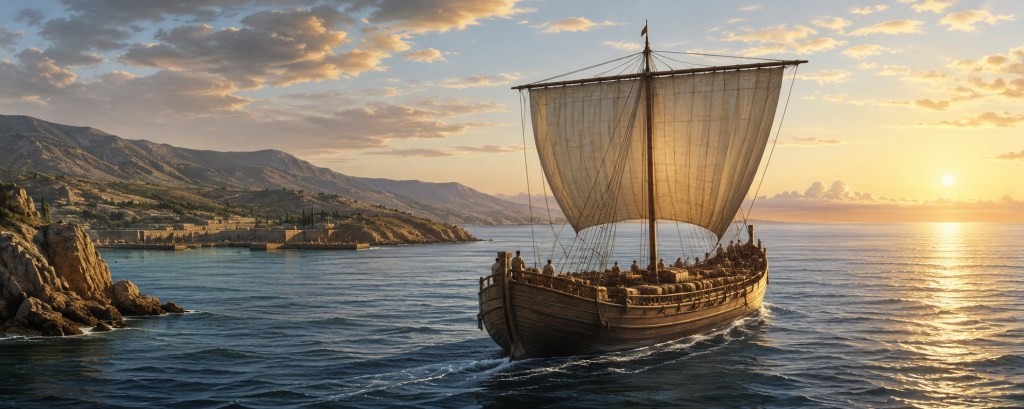
Scripture Focus: Acts 27:1–13
Have you ever been completely convinced that somewhere else would be better than where you were? Perhaps another job appeared less stressful, another home seemed more comfortable, or another season of life promised fewer complications. We are remarkably skilled at imagining that contentment is waiting just a little farther down the road. Apparently, this tendency isn’t new. Nearly two thousand years ago, a ship full of travelers left a perfectly safe harbor because another one looked more appealing—and sailed directly toward a storm.
This story begins with the apostle Paul being sent to Rome. Paul had spent years traveling from city to city, preaching that Jesus Christ had risen from the dead and offering salvation to all who would believe. His ministry had brought him both devoted friends and determined enemies. After being falsely accused and held in custody, Paul exercised his right as a Roman citizen to have his case heard before Caesar. He was finally going to Rome, but certainly not under the circumstances he might once have imagined. He wasn’t boarding the ship as a celebrated missionary with an itinerary tucked beneath his arm. He was traveling as a prisoner under military guard.
Luke, Paul’s faithful companion and the writer of Acts, was aboard the ship and recorded the voyage as an eyewitness. He tells us that Paul was placed under the authority of a Roman centurion named Julius, who belonged to a military unit known as Augustus’ band. As a Roman officer, Julius was accustomed to command and had been entrusted with delivering Paul and several other prisoners safely to Rome. Yet from the beginning of the journey, he treated Paul with an unusual degree of consideration.
When the ship reached Sidon, Julius allowed Paul to leave the vessel long enough to visit fellow believers who lived there. Luke writes, “Julius courteously entreated Paul, and gave him liberty to go unto his friends to refresh himself” (Acts 27:3). That brief visit might seem like a small detail beside everything that follows, but I find it deeply comforting. Before Paul faced one of the fiercest storms of his life, God gave him a place to rest among friends.
We aren’t told what happened during those hours in Sidon. We know only that Paul’s friends refreshed him. Perhaps they listened while he spoke of the long years behind him and the uncertain road ahead. Perhaps they prayed together before he returned to the harbor. Whatever occurred, God used ordinary believers to strengthen His servant before the difficult portion of the voyage began. Sometimes divine provision looks like a simple meal, a familiar face, and a chair offered to someone who has been standing too long.
After leaving Sidon, the voyage became increasingly difficult. The ships of Paul’s day had no engines to push them against an unfavorable wind. They depended heavily upon large sails, experienced crews, and weather that was willing to cooperate. On this journey, the wind wasn’t cooperative. Luke describes it as “contrary,” meaning it blew against the direction they needed to travel. Instead of moving steadily westward toward Rome, the ship had to take a more sheltered route near the islands and coastlines, struggling for every mile.
I can almost hear the heavy sail snapping overhead as sailors pulled at ropes hardened by salt and sea spray. The wooden hull would have creaked beneath the shifting weight of cargo and passengers while the crew repeatedly adjusted their course. A journey that might have been difficult even under favorable conditions became slow and exhausting. Luke says they sailed “slowly many days,” a quiet phrase that contains far more frustration than its few words suggest.
Eventually, they reached a place called Fair Havens on the southern coast of Crete. Its name sounds almost inviting, as though they had finally arrived somewhere peaceful after fighting the wind for so long. Fair Havens offered protection from the open sea, but it wasn’t considered an ideal place to spend the entire winter. The harbor provided safety, yet it apparently lacked the comfort and convenience the crew desired.
By this time, the season for safe sailing was rapidly closing. Luke notes that “the fast was now already past” (Acts 27:9), referring to the Day of Atonement, which occurred in the autumn. Winter was approaching, and sailing across the Mediterranean was becoming increasingly dangerous. Thick clouds could hide the sun and stars upon which ancient sailors depended for navigation, while sudden winds could drive a ship far from its intended course. The men aboard didn’t have weather satellites, radio reports, or an engine powerful enough to outrun an approaching storm. Once the sea turned violent, even experienced sailors could quickly lose control.
Paul therefore warned them not to continue. He said, “Sirs, I perceive that this voyage will be with hurt and much damage, not only of the lading and ship, but also of our lives” (Acts 27:10). He wasn’t the captain, the owner, or a professional sailor. In the eyes of those making the decision, he was simply a prisoner offering an opinion.
The centurion listened, but he chose to trust the shipmaster and the owner of the vessel. From a practical standpoint, that choice probably seemed reasonable. These were the men with maritime experience. They understood ships, winds, harbors, and trade routes. Paul was a traveling preacher and a prisoner. What could he possibly tell seasoned sailors about navigating the Mediterranean?
The majority also wanted to leave. Luke explains that the harbor was “not commodious to winter in,” so most of those aboard advised sailing farther along the coast to another harbor called Phenice, or Phoenix, where they hoped to remain until spring. They weren’t proposing a reckless voyage across the entire sea, nor was their intended destination terribly far away. They simply wanted to move from an inconvenient harbor to a more comfortable one, and that is what makes their decision so recognizable.
No one stood on the deck and announced that they intended to rebel against God. They weren’t shaking their fists toward heaven or deliberately searching for danger. They were weighing expert advice, considering the discomfort of Fair Havens, and choosing what appeared to be the better option. The danger entered quietly through a decision that seemed sensible.
Compromise rarely walks through the front door wearing a sign that says, “This will take you away from God.” More often, it slips in carrying a clipboard and several reasonable arguments. It reminds us that everyone else agrees, points out how uncomfortable obedience has become, and assures us that what we want is waiting just a little farther down the coast. Before long, convenience is making decisions that conviction should have made.
Then the wind changed, and Luke writes, “And when the south wind blew softly, supposing that they had obtained their purpose, loosing thence, they sailed close by Crete” (Acts 27:13). The breeze they had been waiting for finally arrived. It was gentle rather than threatening, and it blew in the direction they wanted to go. The sailors must have felt confirmed in their decision as the sail filled, the ship began to move, and Fair Havens slowly disappeared behind them.
Everything seemed to be working, and that may be one of the most unsettling details in the story. The first result of their decision wasn’t disaster; it was progress. The weather appeared to agree with them, their plan moved forward, and the harbor they preferred seemed within reach. Had anyone questioned the wisdom of leaving, they could have pointed to the soft wind and said, “See? We made the right choice.”
Yet favorable circumstances aren’t always evidence of God’s approval. An open door doesn’t automatically mean that heaven opened it, and an easy road isn’t necessarily the road God has chosen. Scripture tells us, “Trust in the LORD with all thine heart; and lean not unto thine own understanding” (Proverbs 3:5). That doesn’t mean we abandon sound judgment or ignore wise counsel. It means our own reasoning must never be permitted to overrule what God has made clear.
Fair Havens wasn’t the harbor they wanted, but it was the harbor that could have sheltered them. It was ordinary, inconvenient, and perhaps rather dull. Spending the winter there may have felt like putting life on hold while everyone stared at the same shoreline for several long months. I can understand why another harbor sounded appealing. After all, most of us become restless after standing in the grocery line for seven minutes. An entire winter in an unimpressive harbor would have tested the patience of nearly everyone aboard, but Fair Havens was safe.
There are seasons when God asks us to remain in places that do not look impressive. The work feels unnoticed, the progress seems slow, and another opportunity appears far more promising. We begin to wonder whether staying is faithfulness or merely fear. Yet sometimes the holiest decision we can make is to remain anchored until God—not restlessness, discomfort, or popular opinion—says it is time to sail.
As the ship moved away from Fair Havens, the south wind continued to blow softly. The sea offered no warning of what lay ahead, and the people aboard likely believed the hardest part of their journey was behind them. They could not yet see the violent weather gathering beyond the horizon.
The harbor they had rejected was growing smaller in the distance. It hadn’t failed them; they had simply decided it wasn’t enough.
Perhaps that is the question Fair Havens leaves with us: Can we trust God’s provision even when it doesn’t resemble our preference? We often ask Him to lead us toward something better, while He may be asking us to recognize the shelter He has already provided. The safest place isn’t always the most attractive one. Sometimes it is simply the place where God has asked us to stay.
If this Fireside Chat warmed your spirit and sparked fresh resolve to live what you believe, fan that flame with Scripture—“Let the word of Christ dwell in you richly” (Colossians 3:16). Pull a little closer to the Light, and carry it into the week ahead.
👉 Sign up for the free FAST Crash Course in Bible Memorization: http://fast.st/cc/21419


Leave a comment