One thing I appreciate about Scripture is that it does not flatten people into stiff stained-glass figures who float through life without awkwardness, irony, or moments that make you stop and think, “Did that really just happen?” There are places in the Bible where the humor is so dry and understated that it is easy to miss if you read too quickly.
Just for fun, I would like to look a little more closely at a few of those moments. No matter how many times I read these passages, the imagery my mind produces never fails to make me laugh.
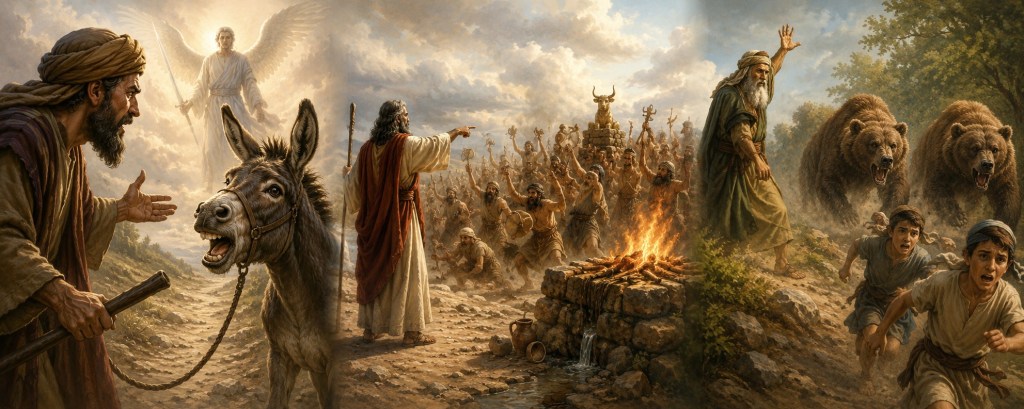
Take Balaam, for example. The man is so angry and fixated on his donkey refusing to move that he completely misses the bigger issue: the donkey is talking. Not braying. Not nudging. Not giving him a stubborn side-eye from the road. Speaking. Personally. Clearly. In words he fully understands. And instead of stopping to say, “Wait a minute… since when do donkeys hold conversations?” Balaam just answers her back like this is a normal part of travel delays.
“And the ass said unto Balaam, What have I done unto thee, that thou hast smitten me these three times?” (Numbers 22:28).
That part always gets me because his frustration is so loud in his own mind that the miracle goes right over his head. He is more concerned with why the donkey will not move than with why the donkey can suddenly explain herself. Meanwhile, the donkey is the one seeing the angel in the road while the prophet himself is spiritually blind. That is funny, yes, but it is also painfully relatable. Sometimes we become so frustrated, offended, determined, or distracted that we completely miss what God is trying to show us standing right in front of us.
Then there is Elijah on Mount Carmel, standing almost alone while 450 prophets of Baal wear themselves out in dramatic fashion. You can almost picture the scene: dust rising into the air, shouting growing louder and louder, prophets limping around the altar, becoming more frantic by the minute, while Elijah watches with the calm confidence of a man who knows heaven is not on mute.
By noon, their performance has reached full volume and still nothing happens. No fire. No voice. No divine spark. Just noise and exhausted men trying desperately to get the attention of a god who cannot answer because he does not exist. And that is when Elijah begins offering his unforgettable commentary:
“Cry aloud: for he is a god; either he is talking, or he is pursuing, or he is in a journey, or peradventure he sleepeth, and must be awaked” (1 Kings 18:27).
In modern terms, Elijah was basically saying, “Maybe your god is busy. Maybe he stepped out for lunch. Maybe he took a nap and needs someone to wake him up.” It is sharp, almost comical, because Elijah is not panicking, pacing, or trying to out-shout anybody. He knows the difference between noise and power. The prophets of Baal are putting on a full religious workout routine while Elijah stands there with the spiritual equivalent of, “Let me know when he picks up.”
That moment is humorous, but it is also deeply powerful. False gods always demand more noise, more striving, more emotional frenzy, and still leave people empty. But when the true God answers, He does not need to be awakened, persuaded, or chased down. He answers by fire.
And honestly, the Elisha and the bears account has to be one of the most abrupt “life comes at you fast” moments in Scripture. The young men mock the prophet, saying, “Go up, thou bald head” (2 Kings 2:23), and before you can comfortably turn the page, two bears come crashing out of the woods like heaven’s emergency disciplinary committee. The whole situation escalates so quickly it almost reads like one of those warning labels nobody thought would ever need to exist: Do not mock the prophet near bear country.
But beneath the startling humor is a serious truth. This was not harmless teasing or innocent playground humor. It was open contempt toward God’s messenger at the very beginning of Elisha’s prophetic ministry. The mockery was aimed at more than his appearance; it was a rejection of the authority and calling God had placed upon him. Scripture reminds us that words are never as small as we pretend they are. “Death and life are in the power of the tongue” (Proverbs 18:21), and sometimes God allows us to see that truth with unforgettable force.
So yes, Scripture gives us moments that are ironic, unexpected, and even strangely humorous. Balaam argues with a donkey like travel plans have simply become inconvenient. Elijah watches false worship collapse into noise and exhaustion while the God of heaven answers by fire. And Elisha’s mockers learn, in the most dramatic outdoor object lesson imaginable, that contempt is never as harmless as it sounds.
That is part of what makes the Bible feel so alive. It captures real people in real moments: angry prophets, exhausted idolaters, stubborn hearts, sharp tongues, blind spots, bad decisions, and divine interruptions. Sometimes the lesson comes through thunder. Sometimes through fire. Sometimes, apparently, through a talking donkey or two bears stepping out of the trees.
But underneath all of it runs the same unshakable truth: God is not mocked, His word is never empty, and even the unexpected moments of Scripture are carrying something eternal.
If this Fireside Chat warmed your spirit and sparked fresh resolve to live what you believe, fan that flame with Scripture—“Let the word of Christ dwell in you richly” (Colossians 3:16). Pull a little closer to the Light, and carry it into the week ahead.
👉 Sign up for the free FAST Crash Course in Bible Memorization: http://fast.st/cc/21419


Leave a comment