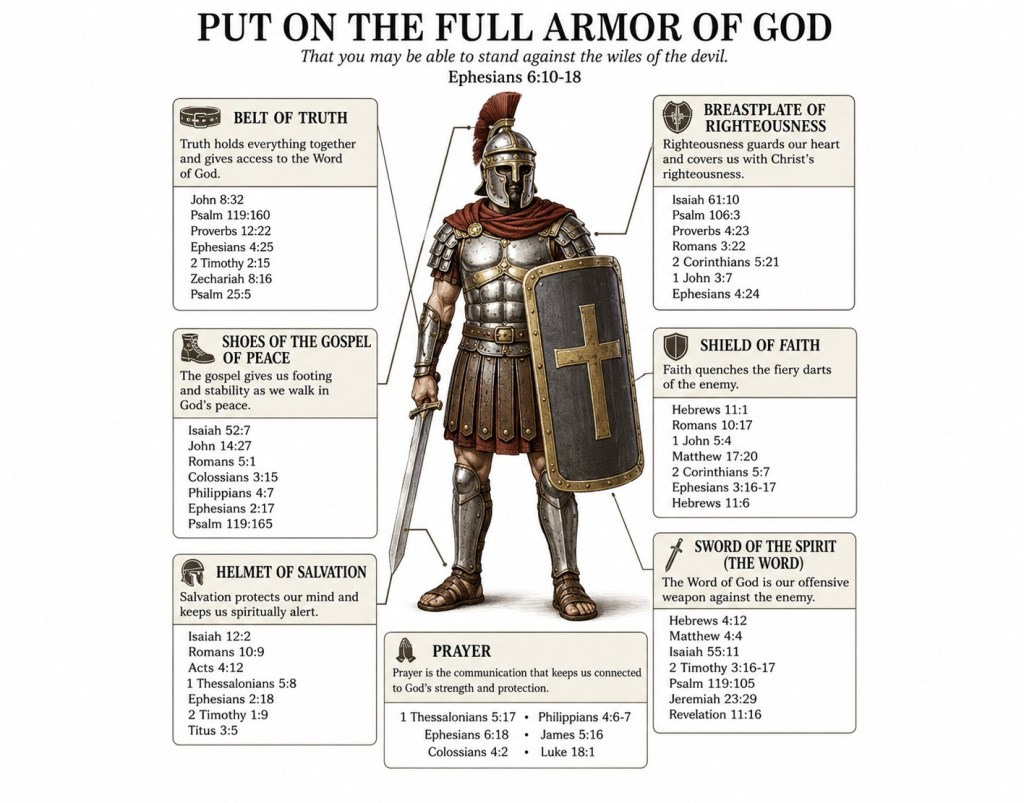
In Ephesians 6:10–18 Paul writes, “Finally, my brethren, be strong in the Lord, and in the power of his might,” then immediately tells believers to “put on the whole armour of God.” God’s armor, not man’s armor. The armor of God is designed for a spiritual battle where the real battlefield is the mind and heart. The Christian is not wrestling “against flesh and blood,” but against spiritual powers, deception, temptation, discouragement, and the enemy’s constant effort to gain control of the inner life. Paul presents the armor as necessary equipment for survival. He doesn’t say believers might face spiritual attack someday; he assumes they already are. Scripture says plainly, “Be sober, be vigilant; because your adversary the devil, as a roaring lion, walketh about, seeking whom he may devour” (1 Peter 5:8). The Christian life is not a playground; it’s a battlefield, and whether people realize it or not, they are already standing somewhere in that conflict.
The first piece is the belt of truth. In ancient armor, the belt held the garments together so the soldier could move freely and fight without becoming tangled. Spiritually, truth does the same thing. It gathers the life together. Without truth, even Bible knowledge can become reckless, misused, or unbalanced. The belt also held the sword, meaning truth gives proper place and access to the Word of God. Truth is not merely something we point at in an argument; it’s something we wear. It keeps the life from becoming loose, exposed, and easily tripped up. And since Jesus said, “I am the way, the truth, and the life” (John 14:6), to wear truth is really to be wrapped in Christ Himself. One of the dangers of the Christian walk is becoming comfortable hearing truth without allowing it to shape the life. Truth was never intended to remain information stored in the mind alone. God’s truth steadies the conscience, exposes deception, corrects compromise, and helps believers recognize the enemy’s lies before they settle into the heart. Satan often works quietly through half-truths, distorted thinking, excuses, distractions, and gradual compromise. The belt of truth protects against becoming spiritually tangled before a believer even realizes it is happening.
The breastplate of righteousness protects the vital organs, especially the heart. This connects with the righteousness of Christ, not self-made goodness. A breastplate over a bare body would pinch, burn, and wound; in the same way, trying to wear outward morality without the robe of Christ’s righteousness becomes painful religion instead of saving faith. The breastplate reminds us that the heart must be guarded by Christ’s forgiveness, Christ’s obedience, and Christ’s covering. The armor is not spiritual self-improvement with metal polish; it is Christ covering, guarding, and transforming the believer. This is important because many people try to fight spiritual battles while relying primarily on their own strength, discipline, or goodness. Eventually that becomes exhausting. Scripture teaches that righteousness is not manufactured by human effort alone but received through Christ and lived out through surrender to Him. Righteousness shapes conduct, choices, habits, words, and desires. Satan understands that if the heart becomes polluted, wounded, bitter, prideful, or hardened, the rest of the spiritual life eventually weakens as well. “Keep thy heart with all diligence; for out of it are the issues of life” (Proverbs 4:23).
The shield of faith is the first line of defense against “all the fiery darts of the wicked.” Ancient shields could cover much of the body, especially when the soldier crouched behind them. Faith does not mean pretending the darts are not real. It means lifting confidence in God before temptation makes contact. Many fall because they wait until temptation is already burning in the lap before resisting it. Faith acts early. It says, “God is faithful,” and reaches for the promised “way to escape” before sin has time to build a little campfire in the imagination. This shield is not flimsy optimism; it is a strapped-on trust in the name, blood, promises, and power of Christ. Scripture repeatedly teaches that Satan attacks through discouragement, fear, accusation, doubt, temptation, and hopelessness. Faith stands between the attack and the soul. It chooses to trust God even before circumstances improve. Roman soldiers often locked shields together in battle, creating a wall of protection. There is significance there for believers as well. Christians were never meant to stand completely isolated from one another. God often strengthens faith through fellowship, encouragement, worship, accountability, prayer, and the support of other believers. Isolation frequently weakens resistance and leaves the mind more vulnerable to discouragement and deception.
The helmet of salvation guards the mind. It is not only meant to keep danger out, but to keep the thoughts settled, clear, and spiritually alert. The mind should not be open to everything simply because it is available. What enters through the eyes, ears, and thoughts shapes the soul more than we sometimes realize. Salvation is not merely something we hope to receive at the end; it is something that protects the thinking now. “Let this mind be in you, which was also in Christ Jesus” (Philippians 2:5). A person wearing the helmet of salvation learns to ask, “Is this strengthening my love for Christ, or quietly training me to live without Him?” This becomes especially important in a world filled with endless noise, entertainment, distraction, confusion, and moral compromise. Satan often works gradually, shaping attitudes and desires long before outward actions appear. The battle for the mind is serious because thoughts eventually influence actions, habits, and character. “For as he thinketh in his heart, so is he” (Proverbs 23:7). The helmet reminds believers that they cannot carelessly feed the mind unhealthy influences all week long and expect spiritual strength to remain unaffected. Salvation changes not only where a person is going someday, but also how they think, process, discern, and respond today.
The shoes of the preparation of the gospel of peace give the soldier footing. Feet represent the direction or walk of the life, and gospel shoes help prevent spiritual slipping and backsliding. Peace is not passive here; it is traction. The gospel steadies the believer in rough country. When we are actively carrying good news—through witness, kindness, testimony, encouragement, and steady Christian living—we are strengthened ourselves. The shoes remind us that truth is not meant to stay in the study notebook. It is meant to walk into homes, conversations, hard days, strained relationships, and ordinary errands with the peace of Christ underfoot. A soldier without proper footing becomes unstable, and spiritually the same thing happens when believers lose sight of the gospel itself. Many people search for peace through comfort, entertainment, distraction, success, or control over circumstances, yet true peace comes from reconciliation with God through Christ. That peace anchors the soul even when life itself becomes rough or uncertain. Paul repeatedly emphasizes standing firm, and stable footing matters greatly in battle. A believer who is grounded in the gospel is far less likely to be swept away by fear, false teaching, pressure from the world, or emotional instability.
The sword of the Spirit, Paul says plainly, “is the word of God.” This is the only clearly offensive weapon in the list, though it also cuts inward. Jesus used Scripture against Satan in the wilderness, answering each temptation with “It is written.” The sword divides truth from error, motive from excuse, and conviction from mere feeling. Hebrews 4:12 says the Word of God is “quick, and powerful, and sharper than any twoedged sword.” A neglected sword grows dull in practice, even if it remains perfect in itself. The believer must keep the Word near, not as a display piece over the fireplace, but as a ready weapon in the hand. This is where Bible memorization becomes deeply practical: when the road gets rocky, the Spirit can bring the Word to the surface of the mind right when it is needed. Many believers underestimate how much spiritual strength comes from consistently filling the mind with Scripture. Jesus did not defeat temptation in the wilderness through emotion, human reasoning, or miraculous display, but through the written Word. Scripture exposes lies, strengthens faith, corrects thinking, convicts the heart, and reminds believers of God’s promises during temptation and discouragement. A Bible left unopened provides little help in the moment of battle. Owning a sword is not the same thing as knowing how to use it.
Paul then adds prayer as the atmosphere in which the armor is worn: “praying always with all prayer and supplication in the Spirit.” Believers need to maintain an attitude of watchfulness. Even excellent armor is little help to a sleeping soldier. Christians must be ready for conflict with the powers of darkness and go to God in prayer when temptations and trials rush in, trusting Him for grace and strength to overcome. Prayer is the fastening of the armor. It is where the soldier checks in with the Commander, receives courage, confesses weakness, and refuses to fight in human strength. This also reminds believers that spiritual strength is not meant to run on yesterday’s experience alone. Just as Israel gathered fresh manna daily, Christians must daily seek Christ through prayer, surrender, obedience, and communion with Him. Jesus Himself regularly withdrew to pray, showing the importance of continual dependence upon the Father. Prayer keeps the heart soft, the conscience sensitive, and the mind alert. Without prayer, even strong believers slowly become spiritually sleepy and vulnerable.
One important truth running through this entire passage is Paul’s repeated emphasis on the whole armor of God. Partial armor leaves exposed places. Some may value truth but neglect prayer. Others may pray while neglecting Scripture. Some may appear outwardly moral while quietly allowing worldly influences to shape the mind and affections. Eventually the unguarded areas become vulnerable points of attack. The armor works together. Truth steadies the life. Righteousness guards the heart. Faith blocks attacks. Salvation protects the mind. The gospel gives stability. The Word fights deception. Prayer keeps the believer connected to God’s strength. Every piece matters because every part of the Christian life matters.
A soldier may admire the shield and sword while overlooking the tiny fasteners keeping everything secured. Yet one broken fastening in battle could become disastrous. The Christian life is often won or lost in the small places nobody applauds. A neglected prayer life. A compromise entertained privately. A bitterness allowed to settle. A careless media habit. A slow drifting from Scripture. Tiny things eventually loosen larger pieces of armor. On the other hand, small acts of faithfulness—daily prayer, memorized Scripture, obedience in hidden moments, honest repentance, guarding the mind—become the little “rivets” that keep the armor secure when the real pressure comes. Most spiritual collapse does not happen all at once. It usually begins subtly, almost unnoticed at first, through little neglected areas that seemed harmless in the moment.
Interestingly, Paul never describes the armor as flashy. Effective armor is not meant to draw admiration to itself; it is meant to help the soldier stand. That alone cuts against much of modern religious culture, which sometimes places more emphasis on appearance than endurance. God is not merely looking for polished-looking soldiers. He is forming steadfast ones—men and women who can remain faithful under pressure, temptation, discouragement, delay, misunderstanding, and spiritual attack. Heaven values endurance far more than performance. Sometimes the strongest believer in the room is not the loudest one, but the one who quietly keeps showing up, keeps praying, keeps obeying, keeps standing, and keeps clinging to Christ when everything around them pressures them to loosen their grip.
Keep in mind, most of the armor is defensive. Believers are not called to reckless spiritual bravado or self-confidence. Three different times Paul emphasizes the word “stand” (Ephesians 6:11,13,14). Victory does not always look dramatic. Often it simply looks like refusing to compromise, refusing to quit, refusing to abandon truth, refusing to surrender the mind to darkness, and remaining faithful to Christ under pressure. The world often admires loud strength, but Heaven also values steadfastness. God does not describe the battle to terrify believers, but to prepare them. Scripture says, “greater is he that is in you, than he that is in the world” (1 John 4:4). The Christian does not fight for victory, but from the position of Christ’s victory already won at Calvary. Yet Scripture also makes clear that this victory is experienced through daily surrender, vigilance, obedience, and dependence upon God. The armor matters because eternity matters. Character matters. The condition of the heart matters. Souls matter. And whether people recognize it or not, every single day they are either standing clothed in the armor of God or attempting to walk through a spiritual battlefield unprotected.
And in a world growing darker by the day, this armor is not optional equipment for the Christian life—it is daily necessity.
As you dig into today’s Study Notes, remember: “This book of the law shall not depart out of thy mouth… for then thou shalt make thy way prosperous” (Joshua 1:8). If you’d like practical help to keep Scripture alive…
👉 Sign up for the free FAST Crash Course in Bible Memorization: http://fast.st/cc/21419


Leave a comment