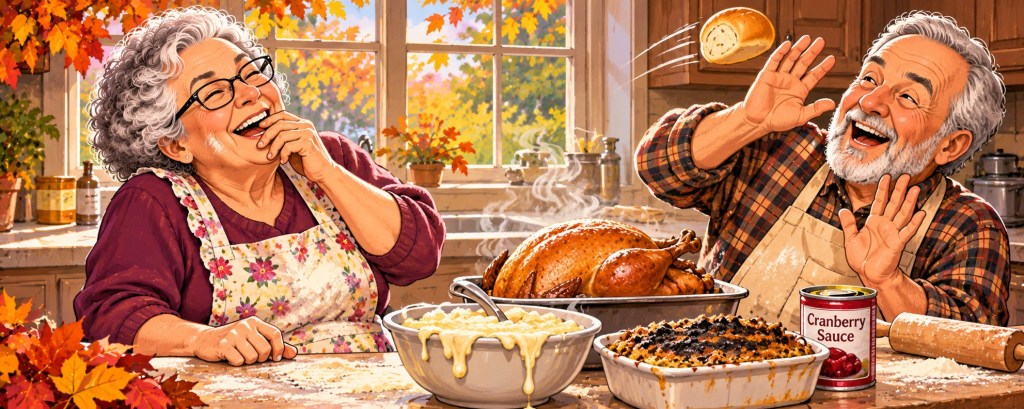
Thanksgiving dinner has a way of bringing out the best in people. It also has a remarkable ability to reveal who should never be allowed to supervise a kitchen.
Mildred had been preparing for Thanksgiving dinner for three days. The grocery shopping was finished, the table was set, and she’d written out a cooking schedule so detailed that it included when to take the butter out of the refrigerator. Everything was going according to plan, which should have been her first indication that trouble was on the way.
By ten o’clock Thanksgiving morning, the turkey was already testing her Christian character. The instructions said it should take approximately four hours to cook, but apparently nobody had consulted the turkey. The skin was turning a beautiful golden brown while the thermometer insisted the inside was nowhere near finished. Harold wandered into the kitchen, surveyed the situation, and made the unfortunate decision to suggest turning up the oven. Mildred slowly turned toward him and asked how many Thanksgiving turkeys he’d cooked in their forty-two years of marriage. When he admitted the answer was none, she smiled sweetly and suggested they not spoil his perfect record. Harold wisely retreated to the living room, where the football game offered a considerably safer environment.
Meanwhile, the mashed potatoes had developed a consistency somewhere between wallpaper paste and modeling clay. Mildred added milk, then butter, then more milk. By the time she finished, they were so thin she considered serving them in coffee mugs. The green bean casserole wasn’t doing much better. Someone had put the crispy onions on too early, and they now resembled something recovered from a fireplace. Then her sister called to ask whether she’d remembered to make the cranberry sauce from scratch. Mildred assured her she had while staring at the unopened can beside the sink. Technically, she reasoned, opening the can would require some effort.
By the time everyone arrived, the kitchen looked as though a small tornado had passed through carrying a bag of flour. Mildred’s hair had escaped its carefully arranged style, her apron had acquired several mysterious stains, and the turkey was still refusing to acknowledge the schedule. Harold, having apparently forgotten his earlier brush with danger, wandered back into the kitchen and asked whether everything was going all right. Mildred looked at him, then at the potatoes, the turkey, and the clock, before informing him that one more question would result in peanut butter sandwiches for everyone, and he’d be making them. He nodded solemnly and disappeared again.
Eventually, dinner made it to the table. The turkey was a little dry, the potatoes were questionable, and the rolls had spent just enough extra time in the oven to qualify as building materials. Nevertheless, everyone gathered around, bowed their heads, and Harold offered the blessing. He thanked the Lord for the food, for the family gathered together, for the home that sheltered them, and for another year of God’s goodness. He thanked Him for the laughter they’d shared, the difficulties they’d come through, and the privilege of being together once again.
Somewhere in the middle of that prayer, Mildred felt her frustration begin to melt. She looked around the table at the familiar faces and realized that she’d spent most of the morning trying to produce the perfect Thanksgiving dinner while nearly overlooking the very blessings she was preparing it to celebrate. There were people she loved, conversations waiting to happen, and memories being made that nobody would remember because the potatoes were perfect. In fact, she suspected the potatoes would be remembered for an entirely different reason.
After the prayer, Harold reached for the serving bowl and examined its contents. He announced that he’d never had mashed potatoes he could pour over his turkey before, and the table erupted in laughter. Mildred gave him a look, but this time she was laughing too. The tension that had been building all morning dissolved somewhere between Harold’s commentary and the realization that nobody seemed particularly concerned about the condition of the meal.
The apostle Paul wrote, “In every thing give thanks: for this is the will of God in Christ Jesus concerning you” (1 Thessalonians 5:18). Notice that he didn’t say to give thanks only when everything goes according to plan. He said in every thing. That doesn’t mean we have to be delighted when things go wrong. It means we can still recognize God’s goodness when they do. Gratitude isn’t dependent upon perfect circumstances, and a disappointing outcome doesn’t erase the blessings that surround us.
Some of our most treasured family memories come from the things that didn’t turn out quite as expected. The burnt rolls become a running joke, the lumpy gravy becomes family legend, and years later someone inevitably asks whether Grandma is planning to serve those famous mashed potatoes with a ladle again. The truth is, a beautiful Thanksgiving doesn’t require a flawless meal, an immaculate house, or a family that behaves like the people in a holiday advertisement. It requires hearts willing to recognize the blessings already sitting around the table.
As everyone began passing the dishes, Harold leaned toward Mildred and whispered that this really was a wonderful Thanksgiving. She smiled and agreed, feeling considerably more thankful than she had an hour earlier. Then Harold suggested that perhaps next year they should order pizza. Mildred reached for a dinner roll, and Harold ducked just in time. Judging by the sound it made when it hit the floor, everyone agreed that those rolls were probably better suited for settling arguments than accompanying dinner.
If this Fireside Chat warmed your spirit and sparked fresh resolve to live what you believe, fan that flame with Scripture—“Let the word of Christ dwell in you richly” (Colossians 3:16). Pull a little closer to the Light, and carry it into the week ahead.
👉 Sign up for the free FAST Crash Course in Bible Memorization: http://fast.st/cc/21419


Leave a Reply