Scripture Focus: “And be not conformed to this world: but be ye transformed by the renewing of your mind, that ye may prove what is that good, and acceptable, and perfect, will of God.” Romans 12:2
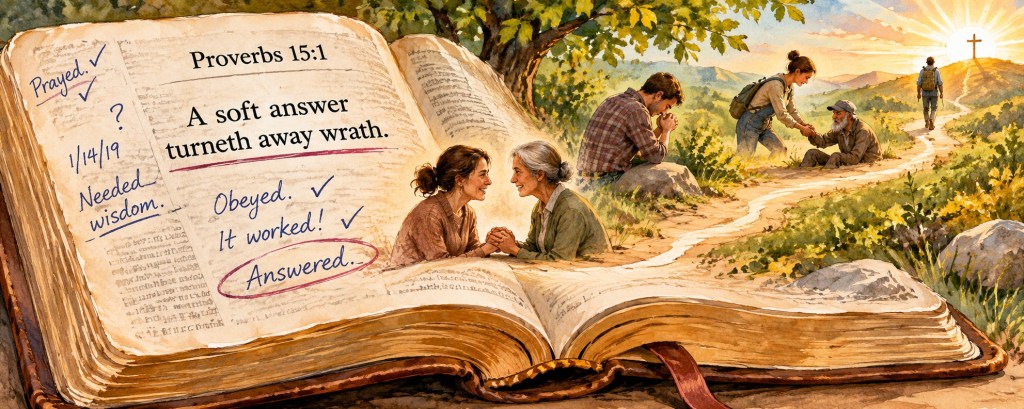
There is something fascinating about an old, well-used Bible. Not one that has spent most of its life looking respectable on a shelf, but one whose pages have been turned so often they no longer lie perfectly flat. Verses are underlined, dates appear beside promises, names are squeezed into corners, and a question mark may sit beside something the reader once struggled to understand. Then, every so often, there is a small notation that says more than a paragraph could: Answered.
The printed words have not changed, but the margins have become a record of what happened when those words met a life.
I think our lives develop margins too. We can know what Scripture says, memorize it, explain it, defend it, and point someone else to the correct verse. Yet there is another kind of knowing that develops when we actually stake something on what God has said. Romans 12:2 uses the word “prove,” not because God’s Word needs our experience to verify that it is true, but because there are things about the goodness of God’s ways that we come to understand more deeply by walking in them.
For example, “A soft answer turneth away wrath” (Proverbs 15:1) is easy enough to underline when nobody is aggravating us. The verse reads quite differently when we are standing in the heat of an argument with a sharp answer already forming on our tongue. When we choose to obey the Word instead, we begin to discover what God knew all along. The same is true of Christ’s words, “It is more blessed to give than to receive” (Acts 20:35). Giving when there is plenty costs very little, but giving when keeping would be easier allows us to experience something about generosity that a definition could never teach.
This is one reason obedience matters so deeply. God is not merely seeking compliant behavior; He is inviting us to live close enough to His Word that His truth becomes woven into our experience. There comes a time when “My grace is sufficient for thee” (2 Corinthians 12:9) is no longer only Paul’s testimony. We have reached the end of our own strength, leaned upon Christ, and discovered that His grace really did hold us. We have not made the verse any truer than it was before, but now its truth has left a mark upon us.
That raises a more searching question: How many verses have I underlined that I have never allowed God to prove in my experience because I have never actually obeyed them?
It is possible to highlight forgive while continuing to nurse an offense, to circle trust while insisting upon controlling every outcome, or to memorize “seek ye first the kingdom of God” (Matthew 6:33) while consistently giving God whatever remains after everything else has received our best. At that point, the issue is no longer whether we know what the Bible says. It is whether our lived experience agrees with our professed belief.
But when belief and obedience do meet, something precious begins accumulating. Over the years, we can look back at places where obedience cost us something, where God’s way made little sense from where we stood, or where trusting Him required releasing what felt safer to hold. Those experiences become part of our testimony—not merely that we knew the promise, but that we rested our weight upon it and found it strong enough to hold us.
That kind of testimony cannot be borrowed from someone else. I may be encouraged by what God has done for you, but eventually faith must become personal. There must be places in my own history where Scripture and experience intersect, where I can look at what God has said and remember what happened when I took Him at His word.
And that is what makes the margins of an old Bible so compelling. They quietly reveal that somebody did more than turn these pages. They wrestled here, prayed here, obeyed here, waited here, and eventually came back with a date, a name, or one little word—Answered.
God has already written the Text. Our privilege is to live so closely by it that, over time, the margins of our lives fill with testimony.
And when we read, “O taste and see that the LORD is good” (Psalm 34:8), we can answer from somewhere deeper than knowledge alone:
I have tasted. And I have found it so.
Reflection Questions
- What truth in Scripture do I understand differently today because I have actually lived in obedience to it?
- Is there something God has clearly shown me in His Word that I continue to agree with intellectually but have resisted putting into practice?
- If the margins of my life recorded my responses to God’s Word, what would they reveal about the relationship between what I profess and how I live?
- What truth might God be inviting me to move from “I believe this” to “I have found this to be so” through obedience today?
Prayer Prompt
Father, thank You that Thy Word is truth whether I have experienced its fullness yet or not. Keep me from being a hearer only. Give me faith to obey what You have spoken and courage to rest my weight upon Your promises. May my life become a testimony that Your ways are good, Your Word is sure, and You are faithful in all that You have promised. Amen.
If this devotional stirred your heart to follow Christ more closely and to walk with purpose, take the next step in His Word—“Thy word have I hid in mine heart, that I might not sin against thee” (Psalms 119:11). Keep your eyes on Jesus and let Scripture dwell richly in you day by day.
👉 Sign up for the free FAST Crash Course in Bible Memorization: http://fast.st/cc/21419


Leave a Reply