Approximate Reading Time: 17 minutes
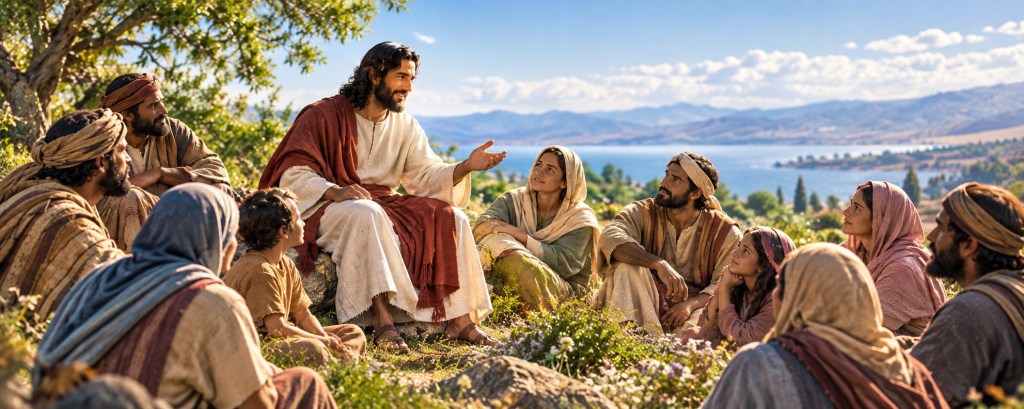
When Jesus sat down on that mountainside and began to teach, He turned the world’s definition of happiness completely upside down. Most of us have a fairly predictable list of things we think would make life better. A little more money would help. Fewer problems would definitely be nice. Good health certainly wouldn’t hurt. We would like our families to be doing well, our prayers answered, our bills paid, our relationships peaceful, and perhaps just one week when absolutely nothing breaks, leaks, quits working, or requires a password we cannot remember. But then… Jesus starts talking about being poor in spirit, mourning, meekness, hunger, mercy, purity, peacemaking, and even persecution. Now that doesn’t exactly sound like the happiness plan most of us would have written, does it?
But Jesus was not giving us eight suggestions for becoming cheerful people. The Beatitudes, found in Matthew 5:3–12, describe the kind of people we become when the kingdom of God gets hold of our hearts. They are not eight unrelated qualities that we somehow paste onto our Christian lives. There’s a beautiful progression here because one naturally leads into another as Christ works within us.
That becomes even more meaningful when we remember who was listening. Israel was under Roman rule, and many of the people were waiting for the Messiah to deliver them. They expected political change, national restoration, and freedom from oppression. In other words, they were looking around and thinking that if all of THIS would change, everything would finally be right. And guess what… we still do that! If this situation changed, if that person changed, if this burden disappeared, if God answered this particular prayer the way we wanted Him to, then surely we could have peace. But Jesus begins somewhere entirely different. He begins with the heart.
THE POOR IN SPIRIT
“Blessed are the poor in spirit: for theirs is the kingdom of heaven” (Matthew 5:3).
Being poor in spirit means we recognize the truth about ourselves: we desperately need God. That sounds simple enough, but self-sufficiency runs pretty deep in human nature. We like to fix things. We make plans, organize, study, work harder, try again, and occasionally give the problem one good shove just to see if brute force will accomplish what everything else has failed to do. Eventually, though, every one of us encounters something we cannot fix, control, undo, or carry in our own strength, and that’s exactly where God can finally do His deepest work.
The poor in spirit come before God with empty hands. There’s no résumé to present, no list of accomplishments that can save us, and no righteousness of our own to offer. We simply recognize, “Lord, I need You.” That’s just pure honesty. Jesus Himself said, “Without me ye can do nothing” (John 15:5). The sooner we understand that, the sooner we stop exhausting ourselves trying to do what only God can accomplish.
There’s also something much bigger underneath this Beatitude. Sin itself began with the opposite spirit. Lucifer said, “I will ascend into heaven… I will exalt my throne… I will be like the most High” (Isaiah 14:13–14). Jesus teaches us to pray, “Thy will be done” (Matthew 6:10). There’s the great controversy in miniature: “I will” versus “Thy will.” One exalts self; the other surrenders self to God. Empty hands are wonderfully easy for God to fill.
THOSE WHO MOURN
“Blessed are they that mourn: for they shall be comforted” (Matthew 5:4).
This one sounds even stranger. We usually think of blessing as the thing that prevents mourning, yet Jesus tells us there is a blessing that can actually meet us in it. Grief has a way of stripping life down to what matters. Things that seemed terribly important yesterday can suddenly lose their shine when the heart is hurting. Sorrow reminds us that this world isn’t what God created it to be, and Scripture never asks us to pretend otherwise. Ecclesiastes says there is “a time to weep” (Ecclesiastes 3:4), and Jesus Himself wept at Lazarus’ tomb. Faith and tears are not enemies.
There’s another kind of mourning here as well. Once we recognize our spiritual poverty, we begin to see sin differently. Sin stops being just some broken rule and becomes something that has actually wounded our relationship with the God who loves us. That’s why Romans 2:4 tells us that “the goodness of God leadeth thee to repentance.” Notice what leads us there—His goodness. It is seeing His goodness so clearly that sin begins to break our hearts because we finally understand what it has done and what it cost Christ to redeem us from it.
Jesus promises that those who mourn will be comforted. He doesn’t promise an explanation for every sorrow or the immediate removal of everything that hurts. Sometimes God changes the circumstance, and sometimes He carries us through it, but He never asks His children to walk through sorrow without Him. “Blessed be God… the Father of mercies, and the God of all comfort” (2 Corinthians 1:3). There are valleys God doesn’t immediately remove from our path because He intends to walk through them with us, and somewhere along that road we discover that comfort isn’t just something God gives. It’s part of who He is.
THE MEEK
“Blessed are the meek: for they shall inherit the earth” (Matthew 5:5).
Meekness has suffered from some really horrendous public relations. We hear the word and picture somebody timid, passive, afraid to speak up, and willing to let everybody walk all over them. That’s not biblical meekness. Jesus described Himself as “meek and lowly in heart” (Matthew 11:29), and nobody could read the Gospels honestly and conclude that Jesus was weak. He confronted hypocrisy, cleansed the temple, stood before hostile religious leaders, and went deliberately to the cross. Meekness is not the absence of strength; it’s strength surrendered to God and brought under His control.
Think about the difference between a clenched fist and an open hand. Both belong to the same person and contain the same physical strength, but one is prepared to strike while the other is available to serve. That’s what surrender does with strength. The meek person doesn’t have to win every argument, receive every bit of credit, or make certain everybody knows exactly what they contributed. There’s tremendous freedom in that. When self is no longer fighting for the center of the room, we become available for God to use.
Moses is described as “very meek” in Numbers 12:3, yet this is the same man who stood before Pharaoh and declared, “Thus saith the LORD God of Israel, Let my people go” (Exodus 5:1). So clearly meekness does not mean being timid. It means knowing whose authority matters. God does not ask us to become smaller people in order to become meek; He asks us to surrender our strength, abilities, opinions, ambitions, and even our rights to Him so that He can determine how they should be used. There is tremendous strength in a life that no longer has anything to prove.
THOSE WHO HUNGER AND THIRST AFTER RIGHTEOUSNESS
“Blessed are they which do hunger and thirst after righteousness: for they shall be filled” (Matthew 5:6).
Most of us understand hunger. When you’re just slightly peckish, you can afford to be picky. But when you are genuinely hungry, you are much less concerned about whether dinner is exactly what you had in mind. Real hunger simplifies things, and Jesus uses that familiar physical craving to describe what eventually happens in the surrendered heart. There’s a big difference between being interested in righteousness and being hungry for it.
Spiritual hunger changes the questions we ask. Instead of wondering how close we can get to the edge without technically crossing the line, we begin asking, “Lord, is there anything standing between You and me?” The Bible becomes more than information, prayer becomes more than presenting God with a list, and obedience becomes more than duty. As our desire for Christ deepens, our desires begin to change as well. We find ourselves wanting what He wants because He is changing our appetite from the inside out.
That’s what makes Jesus’ promise so beautiful: those who hunger and thirst after righteousness “shall be filled.” We are not required to somehow produce the righteousness we are longing for. Titus 3:5 reminds us, “Not by works of righteousness which we have done, but according to his mercy he saved us.” God not only forgives us; He begins changing us, replacing old desires with new ones and shaping our hearts to become more like His. The very righteousness we hunger for is something only He can provide, and when God awakens that hunger in us, we can be certain He already has the Bread to satisfy it.
THE MERCIFUL
“Blessed are the merciful: for they shall obtain mercy” (Matthew 5:7).
Mercy becomes considerably easier to understand when we remember how desperately we need it ourselves. It’s amazing how quickly we can become prosecutors when somebody else fails and defense attorneys when the person in question is us. We know every circumstance surrounding our own mistakes. We remember how tired we were, what somebody else said first, what we intended to do, and why this was really very unusual behavior for us. Then somebody else stumbles and suddenly the jury is seated, the evidence has been presented, and we are halfway to a verdict.
Mercy interrupts that. It doesn’t pretend sin is harmless, excuse wrongdoing, or call evil good. God never asks us to sacrifice truth in order to be merciful. Mercy simply remembers that a person can be wrong and still be precious to God. Jesus illustrated this beautifully in the story of the Good Samaritan in Luke 10:25–37. The Samaritan didn’t just feel sorry for the wounded man and hope somebody else came along to help him. He stopped. Mercy has feet; it moves toward need.
Sometimes mercy looks like forgiveness. Sometimes it means feeding somebody, listening without rushing them, praying for someone who has hurt us, giving another person room to grow, or refusing to broadcast another person’s failure. We become merciful as we understand the mercy God has extended to us. It’s difficult to stand at the foot of the cross, fully aware of how much we ourselves have been forgiven, and remain terribly enthusiastic about throwing stones.
THE PURE IN HEART
“Blessed are the pure in heart: for they shall see God” (Matthew 5:8).
Most of us are pretty good at cleaning the parts people can see. If company is coming, we straighten the room they will sit in, wipe the counters, fluff the pillows, close a door or two, and hope nobody becomes curious about the closet. We can do something similar spiritually. We can tidy up the visible behavior while carefully shutting the door on what’s happening inside.
But Jesus opens closets.
God is not satisfied with a respectable exterior while resentment, pride, jealousy, selfishness, bitterness, or cherished sin quietly take up residence inside. He wants the heart. After his terrible fall, David prayed, “Create in me a clean heart, O God; and renew a right spirit within me” (Psalm 51:10). That word “create” is important because only God can create. Christianity is not primarily a behavior-improvement program. God is doing something supernatural within the surrendered life. His promise is, “A new heart also will I give you, and a new spirit will I put within you” (Ezekiel 36:26).
Jesus says the pure in heart will see God. One day that promise will be wonderfully literal, for Revelation 22:4 says, “And they shall see his face.” But there’s also something happening now. A dirty window doesn’t stop the sun from shining; it simply interferes with our ability to see the light clearly. Sin does something similar in our spiritual lives. Pride distorts our view of God. Cherished sin clouds it. But as God purifies the heart, we begin recognizing His character, His providence, and His presence more clearly.
THE PEACEMAKERS
“Blessed are the peacemakers: for they shall be called the children of God” (Matthew 5:9).
There’s a world of difference between making peace and simply keeping everybody quiet. Sometimes what we call peace is really everybody agreeing not to mention the elephant sitting at the dinner table. Nobody talks about it, nobody looks directly at it, and we just keep passing the potatoes around it. Jeremiah warned about those who said, “Peace, peace; when there is no peace” (Jeremiah 6:14). Ignoring a problem may postpone an argument, but it doesn’t create peace.
Jesus specifically said “peacemakers.” Peacemaking requires participation. Sometimes it requires a difficult conversation, an apology, forgiveness, patient listening, healthy boundaries, or simply deciding that having the last word isn’t nearly as important as we thought it was.
Peacemaking also begins with our own relationship with God. We cannot consistently carry His peace into other relationships while fighting against Him in our own hearts. Jesus said, “In the world ye shall have tribulation: but be of good cheer; I have overcome the world” (John 16:33), so biblical peace obviously cannot mean a trouble-free life. It means there’s a place inside the storm where Christ still reigns. As His peace takes root in us, we become less interested in winning and more interested in healing, less concerned with proving who was right and more concerned with what will honor Christ. Sometimes the most Christlike thing we can bring into a room is His peace, not another opinion.
THE PERSECUTED FOR RIGHTEOUSNESS’ SAKE
“Blessed are they which are persecuted for righteousness’ sake: for theirs is the kingdom of heaven” (Matthew 5:10).
Then Jesus brings us to the Beatitude we probably would have left off the list. We were doing quite nicely with mercy, purity, and peace, and then He reminds us that faithfully following Him will not always make us popular. There’s a reason for that. The principles of Christ’s kingdom run directly against the principles of this world. Humility collides with pride. Purity collides with corruption. Mercy collides with cruelty. Truth collides with deception. Obedience to God eventually collides with human authority whenever human authority demands what God forbids or forbids what God commands.
Scripture never teaches that following Christ will become easier as the great controversy approaches its conclusion. Revelation makes worship and allegiance central issues in earth’s final conflict. Ultimately, the question is the same one that has echoed throughout Scripture: Whom will we obey? That’s why faithfulness must be cultivated now. We cannot spend our lives bending our convictions whenever obedience becomes inconvenient and expect to suddenly develop spiritual backbone when the stakes become enormous.
Daniel didn’t suddenly become faithful when somebody opened the lions’ den. He had been choosing faithfulness long before there were lions involved. The three Hebrews didn’t suddenly develop courage when Nebuchadnezzar heated the furnace. Their answer had already been settled: “Our God whom we serve is able to deliver us… But if not… we will not serve thy gods” (Daniel 3:17–18). There’s something tremendously powerful about that “but if not” faith. God can deliver me, but if not, He is still God. God can change this circumstance, but if not, I will still trust Him. God can remove this opposition, but if not, I still belong to Him. Jesus never promised that righteousness would always be applauded. He promised something infinitely better: the kingdom.
HEAVEN BEGINS HERE
When we put the Beatitudes together, something beautiful emerges. They are not random sayings; they form a picture of what Jesus does with a surrendered human heart. First, we recognize our spiritual poverty: I need God. That realization causes us to mourn what sin has done and leads us to repentance. As self is surrendered, meekness begins to grow. The emptied heart then hungers and thirsts for the righteousness it cannot produce for itself. Having received mercy, we become merciful. As God cleanses the heart, we begin seeing Him more clearly. His peace takes root within us, and we begin carrying that peace into the lives of others. Eventually, that transformed life becomes so different from the spirit of the world that opposition should not surprise us.
The first Beatitude and the last end with exactly the same promise: “theirs is the kingdom of heaven” (Matthew 5:3, 10). It’s almost as though Jesus placed the entire progression inside a pair of heavenly bookends. We begin by discovering that without Him we have nothing, and we arrive at the place where we understand that even if this world takes everything from us, as long as we have Christ, we still possess everything that ultimately matters.
That’s why the Beatitudes are about far more than happiness. They describe citizens of another kingdom. Enoch “walked with God” (Genesis 5:24), which may be one of the simplest and most beautiful descriptions of the Christian life anywhere in Scripture. Day after day, choice after choice, Enoch walked with God until heaven was not foreign territory to him. That’s the work Christ desires to accomplish in us.
We are waiting for Jesus to return and take us home, but preparation for heaven isn’t just knowing prophecy, understanding last-day events, or being able to explain what happens next. Those truths matter, but God is also preparing a people whose characters reveal the principles of His kingdom. He is teaching us humility in a proud world, mercy in a cruel one, purity in a corrupt one, peace in an angry one, and faithfulness in a world increasingly uncomfortable with truth.
Jesus said, “Blessed” eight times because heaven’s idea of the blessed life is very different from ours. We tend to think blessing means God making the road easier. Sometimes His greater blessing is what He is making of us while we travel it. He is not merely preparing a place for us; He is preparing us for the place. And that is the hidden beauty running through the Beatitudes: heaven does not begin only when we finally walk through the gates of the New Jerusalem. Its principles begin taking root right here, when the King is allowed to reign in the heart.
As you dig into today’s Study Notes, remember: “This book of the law shall not depart out of thy mouth… for then thou shalt make thy way prosperous” (Joshua 1:8). If you’d like practical help to keep Scripture alive…
👉 Sign up for the free FAST Crash Course in Bible Memorization: http://fast.st/cc/21419


Leave a comment