Judges 5 is Deborah and Barak’s song of victory following the events of Judges 4, but understanding the song requires knowing what brought Israel to this point.
After the death of Ehud, “the children of Israel again did evil in the sight of the LORD” (Judges 4:1). God allowed them to fall under the oppression of Jabin, king of Canaan, whose military commander, Sisera, had nine hundred iron chariots and “mightily oppressed the children of Israel twenty years” (Judges 4:3). When Israel cried unto the Lord, God worked through Deborah, a prophetess and judge, who called Barak to lead ten thousand men against Sisera’s army. The Lord routed Sisera’s forces, and Sisera fled on foot to the tent of Jael, where the seemingly invincible commander met his end with a tent peg and hammer.
Judges 5 looks back upon those events, but Deborah’s song does much more than celebrate a military victory. It gives us a glimpse beneath the battlefield and reveals something about Israel’s spiritual condition, the consequences that followed, and the very different ways people responded when God called them to act.
As I read Judges 5, I found myself paying particular attention to the progression Deborah describes in verses 6–8. Israel did not suddenly wake up one morning to find everything broken. Something had happened spiritually first: “They chose new gods; then was war in the gates” (Judges 5:8).
Then the effects began showing up in everyday life. “The highways were unoccupied, and the travellers walked through byways” (verse 6). People changed where and how they traveled because the normal roads were no longer safe. Village life deteriorated until Deborah says, “The inhabitants of the villages ceased” (verse 7). Fear had worked its way into ordinary life, and eventually trouble was no longer somewhere beyond Israel’s borders. It had reached their gates.
I could not read that progression without thinking about the world we are living in now. When people increasingly turn away from God, the consequences eventually spill beyond individual hearts and into families, communities, and society itself. Jesus said of the last days, “And because iniquity shall abound, the love of many shall wax cold” (Matthew 24:12). Paul describes a similar deterioration in 2 Timothy 3:1–5. What begins spiritually eventually becomes visible practically.
But there’s one little word in Judges 5:7 that stopped me: “until.”
“The inhabitants of the villages ceased, they ceased in Israel, until that I Deborah arose, that I arose a mother in Israel.”
That “until” feels like a shaft of light breaking through the passage. Deborah could see what had happened to her nation, but she didn’t just lament it. God raised her up in the middle of it. Then leaders stepped forward and people “willingly offered themselves” (Judges 5:2, 9). Places that had once echoed with “the noise of archers” became places where people would “rehearse the righteous acts of the LORD” (verse 11). God turned places associated with fear into places of testimony.
That makes the rest of the song much more personal to me because Deborah begins naming those who answered God’s call—and those who didn’t.
Several tribes came forward. Ephraim, Benjamin, Machir, Zebulun, Issachar, and Naphtali participated. Zebulun and Naphtali even “jeoparded their lives unto the death” (verse 18). But Gilead remained beyond Jordan, Dan stayed with his ships, and Asher remained along the seashore.
And then there was Reuben.
Reuben especially caught my attention because he wasn’t indifferent. Twice Scripture tells us there were “great thoughts of heart” and “great searchings of heart” among his people (Judges 5:15–16). They apparently wrestled seriously with what was happening around them. Yet when others entered the battle, Reuben remained among the sheepfolds “to hear the bleatings of the flocks.”
That can be a rather uncomfortable little mirror.
It’s possible to recognize what’s happening around us, be deeply concerned about it, pray about it, discuss it, and still never actually respond to what God is asking us to do. James says, “But be ye doers of the word, and not hearers only” (James 1:22). Reuben searched his heart; Zebulun and Naphtali moved their feet.
And tucked into verse 14 is a detail I absolutely love. Among those who answered were “they that handle the pen of the writer.” That little phrase practically waved at me from the page.
Not everyone entered this battle carrying the same thing. There were leaders, governors, soldiers, Deborah, Barak—and people who handled a pen. Deborah repeatedly praises those who “willingly offered themselves” (Judges 5:2, 9). God didn’t require everyone to serve Him in the same way. He required willingness.
That’s what speaks most strongly to me about this passage, especially when I look at our world today. I cannot repair a culture. I cannot personally stop everything I see deteriorating around me. But neither am I called to sit among the sheepfolds having “great searchings of heart” while the sheep provide background music.
I am called to willingly offer myself to God.
And whatever He has placed in my hand—even if it’s only a pen—I want Him to find it available.
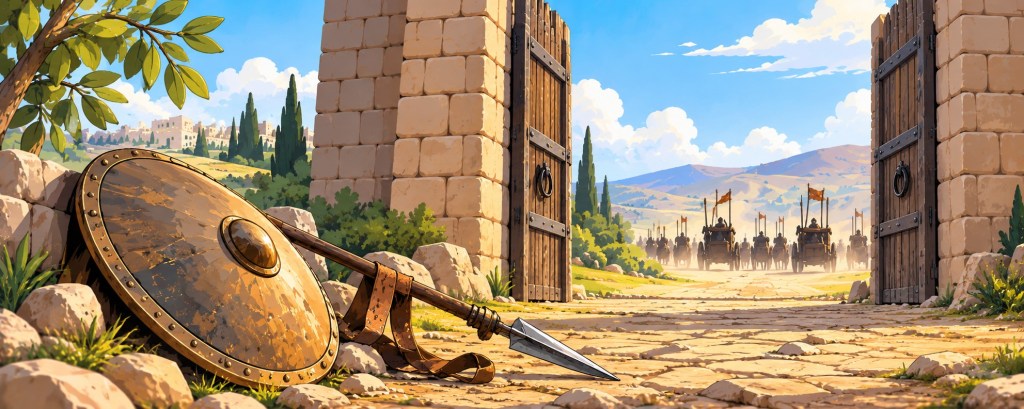
There’s another part of this passage that has really made me stop and think. Judges 5:8 connects two striking conditions: “They chose new gods; then was war in the gates,” followed immediately by, “was there a shield or spear seen among forty thousand in Israel?” Why does Scripture place Israel’s spiritual apostasy beside its apparent defenselessness? Is there a larger biblical principle here about what happens to God’s people when they exchange dependence upon Him for the gods of their culture? And could spiritual compromise leave God’s people just as unprepared for the final conflict as Israel was for the battle at its gates?
I can see several layers to the answer, and I truly value other’s insights as well.
First, Israel’s lack of weapons was probably both literal and spiritually significant within the narrative. The Canaanites had nine hundred iron chariots (Judges 4:3), while Israel appears desperately under-equipped. Later, 1 Samuel 13:19–22 describes another period when Israel’s enemies deliberately restricted their access to weapons. Oppression could produce very real military helplessness.
But Deborah places that helplessness immediately after, “They chose new gods; then was war in the gates.” Israel had exchanged the God who had repeatedly defended them for gods that couldn’t defend them at all. Moses had warned Israel long before: “How should one chase a thousand, and two put ten thousand to flight, except their Rock had sold them” (Deuteronomy 32:30). Israel’s real strength had never been its weaponry. Their security rested in their relationship with and dependence upon God.
That leads to another layer. False gods promise what they’re incapable of providing. Israel chose the gods of the surrounding culture, presumably because those gods appeared to offer prosperity, fertility, security, or acceptance. Yet when war reached the gates, those gods had nothing with which to answer it. There’s almost an irony in Judges 5:8: Israel traded the living God for gods they found desirable and discovered, when crisis came, that their substitutes couldn’t save them.
Isaiah later makes essentially the same point about idols: “they bear him upon the shoulder… and set him in his place… yea, one shall cry unto him, yet can he not answer, nor save him out of his trouble” (Isaiah 46:7).
Then there’s the spiritual application to God’s people. The New Testament identifies our real warfare as spiritual: “For we wrestle not against flesh and blood” (Ephesians 6:12). Our weapons are spiritual as well: “For the weapons of our warfare are not carnal, but mighty through God” (2 Corinthians 10:4). Paul describes truth, righteousness, faith, salvation, the gospel, and “the sword of the Spirit, which is the word of God” (Ephesians 6:14–17).
That creates a sobering parallel. Israel had an enemy at the gates and scarcely a weapon among forty thousand. Could the final generation likewise face a tremendous spiritual conflict while being tragically unprepared for it?
That brings me straight to Laodicea.
Laodicea says, “I am rich, and increased with goods, and have need of nothing,” while Christ says she does not know that she is “wretched, and miserable, and poor, and blind, and naked” (Revelation 3:17). Her most dangerous condition isn’t just weakness. It’s weakness combined with the conviction that she’s adequately equipped.
From what I see here, Israel’s problem wasn’t ultimately that there weren’t enough swords in the cupboard. Their outward defenselessness exposed an inward reality: they had separated themselves from the Source of their strength.
And that gives Judges 5:8 a very serious end-time relevance. Could God’s people become so accommodated to the “gods” of the surrounding culture—self-sufficiency, materialism, entertainment, human wisdom, comfort, or anything else that competes for God’s place—that we gradually lay aside the very spiritual weapons we will desperately need when “war” reaches the gates?
There’s one more piece I find especially interesting: God still won without Israel’s weapons.
As you dig into today’s Study Notes, remember: “This book of the law shall not depart out of thy mouth… for then thou shalt make thy way prosperous” (Joshua 1:8). If you’d like practical help to keep Scripture alive…
👉 Sign up for the free FAST Crash Course in Bible Memorization: http://fast.st/cc/21419
 Star for the Journey
Leave a comment