“Now faith is the substance of things hoped for, the evidence of things not seen.” — Hebrews 11:1
By the winter of 1941, hunger had settled over Leningrad with a severity that is difficult for those of us who have never experienced famine to imagine. The German army had encircled the city in September, cutting ordinary supply routes and beginning a siege that would last nearly two and a half years. Food became desperately scarce, and during the worst period some civilians received bread rations of only 125 grams a day. People weakened until ordinary tasks became exhausting. Fuel disappeared, buildings went unheated, and the bitter Russian winter entered homes and workplaces through broken windows and inadequately heated rooms. People were not wondering what they would have for dinner. They were wondering whether there would be anything to eat at all.
Yet in the middle of that starving city stood a building on St. Isaac’s Square containing something almost unimaginable under the circumstances: an enormous collection of edible seeds and crop plants.
The collection belonged to the All-Union Institute of Plant Industry and had been built largely through the vision of Russian botanist Nikolai Vavilov. For years, Vavilov had traveled and organized expeditions across the world, gathering varieties of wheat, rice, barley, corn, beans, peas, and countless other cultivated plants and their wild relatives. He understood something remarkably forward-looking for his time. A seed was more than something that could be ground into flour or cooked for supper. Hidden within different varieties were genetic characteristics that might someday help plant breeders confront disease, drought, changing growing conditions, or agricultural problems no one could yet foresee.
By the time war came, the institute possessed one of the greatest collections of plant diversity in the world. Some of that material was eventually evacuated from Leningrad, but much of the collection remained behind. And so, while hunger tightened its grip upon the city, scientists found themselves surrounded by something they desperately needed for one purpose but had been entrusted to preserve for another.
That is the part of the story I cannot easily get past.
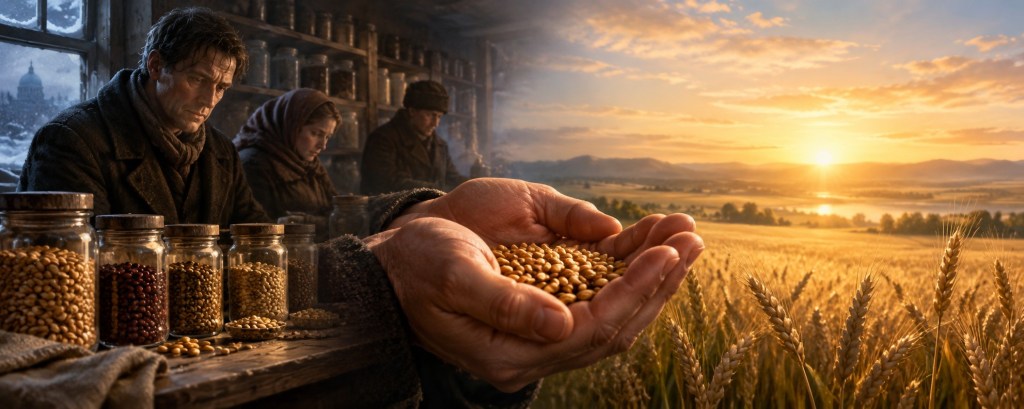
These were not merely specimens preserved for study. The rice, wheat, peas, and beans were food the scientists could have eaten, even as their own bodies weakened from hunger.
The scientists understood the temptation well enough that they did not pretend it wasn’t there. Rooms containing important portions of the collection were sealed, and staff members were not permitted to enter them alone. They worked in groups and organized watches over the building. Their precautions acknowledged something deeply human: they were being asked to protect food at a time when their own bodies were desperate for it.
The institute’s potato collection presented a particularly difficult problem because living plant material had to be kept from freezing and periodically regenerated. Vadim Lekhnovich, who helped care for it, later described fighting three enemies during the siege: rats, freezing temperatures, and starving people. With fuel desperately scarce, keeping the potatoes from freezing meant finding combustible material and maintaining enough heat to preserve them while winter temperatures plunged outside. Lekhnovich himself became severely weakened by hunger, yet the collection survived.
Then spring came, but their responsibility did not end with surviving the winter. Some of the stored seeds were losing their ability to germinate and had to be planted so that fresh seed could be harvested and the varieties preserved. Institute workers continued planting, tending, and harvesting around Leningrad even under wartime conditions and artillery fire.
All the while, the people doing this work were hungry. Nine institute scientists are documented as having died of starvation during the siege while the edible collection they helped protect remained untouched.
I wonder what those rooms must have looked like to someone whose body was starving. Surely there were moments when the scientific importance of genetic diversity felt terribly distant compared with the immediate need for one more meal. Yet these men and women understood that consuming the collection could satisfy an urgent need in the present while destroying something that could never simply be replaced once the crisis had passed.
They could see the seeds in front of them. What they could not see were the fields those seeds might one day produce.
The more I thought about that, the more I began thinking about the things God places in our own hands. We may never face a choice as desperate as theirs, but we do face the question of what to do with what has been entrusted to us.
Not everything He gives us is meant merely to make our present lives easier, fuller, or more comfortable. Time, ability, knowledge, experience, money, influence, words, and opportunities can all be consumed in the present, and there is nothing inherently wrong with enjoying God’s gifts. But stewardship asks a larger question: Is everything God has placed in my hand intended for me, or has some of it been entrusted to me because He intends to produce something from it beyond me?
Some things are provision for today. Some things are seed for tomorrow, and wisdom is learning the difference.
I can hold a handful of wheat kernels and see nothing resembling a field. There is no waving grain, no flour, no bread, and certainly no harvest. All of that exists only in possibility until the seed is preserved, planted, and given time to become what God designed it to become.
Faith often asks us to live in that distance between seed and harvest. “Now faith is the substance of things hoped for, the evidence of things not seen” (Hebrews 11:1). I have often thought about that verse in terms of trusting God for something I cannot yet see, but there is another side to it. Sometimes faith means investing what God has placed in my hands in a harvest I may never personally witness.
A prayer can be seed when I pray year after year and see little evidence that anything is changing. A conversation can be seed when I speak truth in love and the person appears completely unmoved. The lessons God has taught me through mistakes, disappointments, joys, and painful seasons can become seed when I share them rather than allowing them to remain merely part of my own history. Time invested in another person can be seed. Encouragement can be seed. Something written quietly at a kitchen table can become seed in the hands of someone the writer may never meet.
We naturally want to see what becomes of what we give. We want the answered prayer, the changed life, the visible result, the reassurance that our effort mattered. Yet Jesus leaves room for an entirely different experience: “One soweth, and another reapeth” (John 4:37).
Nikolai Vavilov himself became an extraordinary example of that, although not in a way he would ever have chosen. The man whose vision had created the collection was not standing beside his colleagues during the siege. He had been arrested in 1940 after falling victim to the political campaign surrounding Trofim Lysenko’s agricultural doctrines. While the scientists in Leningrad were protecting the collection Vavilov had spent much of his life building, he was imprisoned hundreds of miles away in Saratov.
In January 1943, while the siege of Leningrad was still underway, Vavilov died in prison after suffering severe malnutrition and illness. The man who had traveled the world gathering seeds in the hope of protecting future food supplies died without knowing how much of his life’s work would survive.
Vavilov had gathered the seeds. His colleagues guarded them, and some planted and regenerated threatened varieties during the siege. After the war, still others undertook the enormous work of evaluating what remained and producing fresh seed from varieties whose ability to germinate had become dangerously low. The collection survived not because one person carried the work from beginning to end, but because one person’s labor became another person’s stewardship.
Psalm 126:6 says, “He that goeth forth and weepeth, bearing precious seed, shall doubtless come again with rejoicing, bringing his sheaves with him.” Those two words strike me differently after learning the story of Leningrad: precious seed. Its worth is not limited to what I can see while it is sitting in my hand.
Those scientists understood that in a painfully literal way. They protected something small enough to hold in their hands because they understood that its greatest value might belong to a future they could not see. They did not know which varieties would someday be needed, who would plant them, or who would gather the harvest. Some did not even live long enough to see the collection safely through the siege. They simply remained faithful to what had been entrusted to them.
I think that is what I want to remember when I look at the things God has placed in my own hands. I do not have to see the field before I value the seed, nor do I have to know what the final harvest will look like before I faithfully use what He has entrusted to me. Some things God gives us are provision for today, but others may carry possibilities far beyond our sight and even beyond our lifetime. My part is to recognize the difference, be faithful with what He has placed in my hands, and trust Him with whatever harvest He intends it to produce.
If this Fireside Chat warmed your spirit and sparked fresh resolve to live what you believe, fan that flame with Scripture—“Let the word of Christ dwell in you richly” (Colossians 3:16). Pull a little closer to the Light, and carry it into the week ahead.
👉 Sign up for the free FAST Crash Course in Bible Memorization: http://fast.st/cc/21419
 Star for the Journey
Leave a comment