Estimated reading time: 12 minutes
Scripture Focus: Acts 20:17–23:35
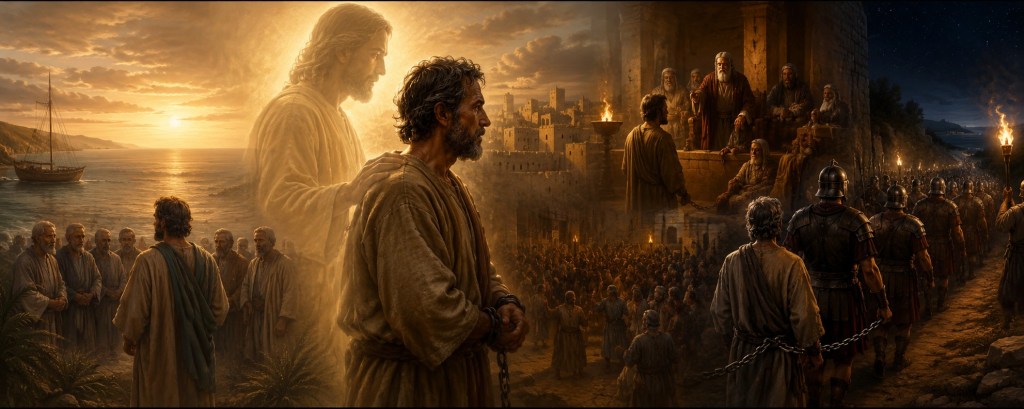
Paul stood on the shoreline at Miletus looking into faces he loved.
The men gathered around him were not strangers. They had prayed together, wept together, watched churches planted together, and seen God do things none of them could’ve imagined when they first began the journey. Now Paul was saying goodbye, and somehow they all seemed to know that this farewell carried an unusual weight.
His words were not those of a man looking back with regret, but of one looking ahead with settled conviction. The Holy Spirit had made one thing unmistakably clear: imprisonment and suffering awaited him in Jerusalem. Most of us would probably have taken that as a reason to reconsider the trip. Paul received it as preparation rather than prohibition. He never questioned whether he should continue; he only became more determined to finish what Christ had given him to do. “None of these things move me,” he said, “neither count I my life dear unto myself, so that I might finish my course with joy” (Acts 20:24).
That statement becomes the key that unlocks every chapter that follows.
As the ship made its way toward Jerusalem, the warnings continued. At Tyre, believers pleaded with Paul not to go. Later, the prophet Agabus took Paul’s girdle, bound his own hands and feet, and foretold what awaited him. Their concern was genuine, and their tears reflected how deeply they loved him. If I had been standing there, I suspect I would’ve joined them. Love naturally wants to shield those it cares about from pain.
But Paul understood something they had not yet grasped. God had not revealed these things to persuade him to turn back. He had revealed them so Paul would not lose heart when they came to pass. There’s a profound difference between a warning meant to redirect our steps and one meant to prepare our hearts. God wasn’t changing Paul’s destination; He was strengthening him for the road that led there.
When Paul finally arrived in Jerusalem, the trouble he encountered came from an unexpected direction. James and the elders rejoiced over the remarkable work God had accomplished among the Gentiles, yet they also explained that many Jewish believers had heard troubling reports about him. Rumor had done what rumor has always done—it had outrun the truth.
Thousands of years have passed, and misinformation still seems capable of traveling without ever stopping to ask whether it’s true.
Rather than defend his reputation, Paul willingly laid aside personal preference for the sake of preserving unity. He agreed to participate in the purification rites, not because salvation depended upon ceremony, but because he refused to let unnecessary misunderstanding become a barrier to the gospel. There’s a quiet humility in that decision that I deeply admire. It’s one thing to stand firmly when truth is at stake. It’s another to insist upon our own rights when only our pride is involved.
His willingness, however, didn’t prevent what came next.
Some Jews from Asia recognized Paul in the temple and immediately stirred up the crowd, accusing him of teaching against the people, the law, and the temple itself. Then they added another accusation—that he had brought a Gentile beyond the place where Gentiles were permitted to enter. Luke quietly tells us why they believed this: they had previously seen Paul in the city with Trophimus the Ephesian and simply supposed he had taken him into the temple.
That little word has lingered with me.
Supposed.
One assumption. One conclusion drawn without evidence. One rumor accepted as fact. It was enough to turn an entire city into an angry mob and nearly cost an innocent man his life. We often imagine that history is changed by great speeches and decisive battles, yet here Luke reminds us that history can also be altered by something as ordinary—and as dangerous—as an unchecked assumption.
The temple doors were shut behind the crowd, almost as though religion itself had closed its ears while violence took over. Paul was dragged into the streets and beaten so severely that, had the Roman commander not intervened, his journey would likely have ended there.
Yet even that interruption was moving the story forward. .
It’s striking that throughout these chapters Paul seems to lose control of nearly everything. He loses his freedom. He loses his reputation. He loses the ability to decide where he will go next. One moment he’s walking freely through the streets of Jerusalem; the next he’s bound with chains, surrounded by soldiers, and being carried up the steps of the Roman fortress to escape the fury of the crowd.
From a human perspective, it looks as though everything is unraveling.
From heaven’s perspective, nothing is.
As Paul reached the staircase, he did something I’m sure I wouldn’t have thought to do. He asked for permission to speak.
That still amazes me.
He did not see a hostile crowd. He saw souls.
The very people who had just tried to kill him became the audience to whom he longed to tell the story of Jesus. Standing there bruised, chained, and surrounded by Roman soldiers, Paul began speaking, not about the injustice he had suffered, but about the mercy he himself had received. He told them of his former zeal, of the bright light that met him on the road to Damascus, of the voice that called his name, and of the Savior who transformed the persecutor into a preacher.
His testimony was never really about himself.
It was always about Christ.
The crowd listened with surprising attention until Paul spoke of Christ sending him to the Gentiles. At that point their anger erupted once again, and the opportunity to reason quietly disappeared beneath another wave of shouting.
The following day brought Paul before the Sanhedrin. If anyone could’ve untangled the misunderstanding, surely it would’ve been the nation’s highest religious council. Instead, the hearing quickly dissolved into confusion. Before Paul had spoken more than a few sentences, he was struck across the mouth at the command of the high priest. Moments later the Pharisees and Sadducees were arguing so fiercely with one another that the Roman commander feared Paul would literally be torn apart and ordered the soldiers to rescue him yet again.
Reading these chapters has made me appreciate something I had not noticed before.
God never promised Paul a peaceful journey to Rome.
He promised that Paul would reach Rome.
Those are not the same thing.
Sometimes we assume that if we are walking in God’s will, the path ought to become clearer, smoother, or at least a little easier to explain. Paul’s experience challenges that assumption. Every step of obedience seemed to invite another obstacle, yet not one of those obstacles had the power to cancel what Christ had already spoken.
That truth shines most brightly after the shouting finally subsides.
Luke records that “the night following the Lord stood by him” (Acts 23:11). I love that picture. Jesus didn’t keep Paul from every hardship, but neither did He leave him to face them alone. After the accusations, the blows, the confusion, and the loneliness, Christ simply stood beside His weary servant and spoke words Paul desperately needed to hear: “Be of good cheer… for as thou hast testified of me in Jerusalem, so must thou bear witness also at Rome.”
With those words, Rome ceased to be merely a destination.
It became a promise.
Everything that follows must now be read in the light of that promise, because the story is no longer asking if Paul will reach Rome. Jesus has already answered that question. Every chain, courtroom, delay, and danger would now become part of the road by which that promise was fulfilled.
The very next morning, however, another scene unfolded that Paul knew nothing about.
While he was under Roman guard, more than forty men gathered together and bound themselves under an oath that they would neither eat nor drink until Paul was dead. It’s remarkable how determined people can become when they are convinced they’re defending God, even while fighting against His purposes. These men sincerely believed they were protecting their faith, yet they were plotting the murder of the very man Christ had called to proclaim the gospel.
What strikes me just as much is what Luke does not tell us.
He never says Paul learned of the plot.
He never describes Paul anxiously wondering what might happen next.
He simply shifts our attention to someone we have never met before—Paul’s young nephew.
Almost unnoticed, this unnamed young man overheard the conspiracy. He could easily have dismissed what he heard as someone else’s problem or assumed that surely someone more important would deal with it. Instead, he quietly did what he could. He went to Paul, Paul sent him to the Roman commander, and the commander listened.
I find that encouraging.
God often advances His work through people whose names history scarcely remembers. We know almost nothing about Paul’s nephew. We’re never told his age, what became of him, or whether he ever appears again. Yet for one brief moment he became the link between a conspiracy and God’s unfolding purpose. Heaven keeps reminding us that faithfulness is measured far more by obedience than by visibility.
The Roman commander immediately recognized the seriousness of the situation. Luke had already hinted that Claudius Lysias believed Paul had committed no crime worthy of death. In fact, after examining the accusations, he concluded that the dispute centered on questions of Jewish law rather than any offense deserving imprisonment. He also knew something else that changed everything: Paul was a Roman citizen.
That mattered.
Roman law expected its officers to protect its citizens, and the commander understood that if an armed mob succeeded in murdering a Roman citizen while he stood by, he would answer for it himself. From a military standpoint, overwhelming force was simply the wisest course of action.
Yet while Claudius Lysias was acting from professional duty, heaven was directing the story.
Before the city awoke, orders had already been given. Horses were gathered. Soldiers assembled. A letter explaining the situation was carefully written to Governor Felix. Then, under the cover of darkness, Paul left Jerusalem surrounded by an escort unlike anything I had ever stopped to consider before.
Luke records the numbers almost matter-of-factly: two hundred soldiers, seventy horsemen, and two hundred spearmen.
I had to pause when I read that.
Four hundred seventy men…
to protect one preacher.
The contrast is almost startling.
Forty men secretly pledged themselves to Paul’s destruction.
Four hundred seventy soldiers were sent to ensure his safe arrival.
The conspirators imagined they held Paul’s future in their hands. Meanwhile, God was quietly moving Roman officials, organizing military escorts, preparing horses, and writing letters that would carry His servant safely toward the very destination Christ had already promised.
Claudius Lysias probably believed he was transporting an important prisoner whose legal rights required protection.
The soldiers probably thought they were carrying out another routine assignment.
Paul himself may not have known the full size of the escort surrounding him as they traveled through the night.
Only God saw the whole picture.
Looking back over the entire journey, I find myself smiling at how many people assumed they were directing Paul’s future. .
The Ephesian elders hoped he would be spared. Loving believers pleaded with him not to continue. James and the elders sought a peaceful solution. A furious crowd decided he deserved to die. The Sanhedrin believed they would judge him. More than forty men convinced themselves they would end his life. Claudius Lysias thought he was managing a political crisis, and Governor Felix assumed another troublesome prisoner was arriving at his court.
Yet through every scene, another Hand was quietly at work.
Long before the mob filled the streets, Christ knew where His servant would stand.
Long before forty men whispered together in secret, God had already placed an attentive nephew within earshot.
Long before the Roman commander called for soldiers, Jesus had already promised that Paul would bear witness at Rome.
Perhaps that’s why the closing scene has stayed with me.
As darkness settled over Jerusalem, the city slept through one of the strangest processions in the book of Acts. Luke records it almost without comment. Nearly five hundred Roman soldiers disappeared into the darkness, escorting one chained preacher toward Caesarea. Most of them believed they were simply protecting a Roman citizen.
Anyone watching that long procession would have seen Rome’s protection surrounding Paul. What they could not see was the Escort who had walked beside him from the shores of Miletus, remained with him through every warning, every farewell, every misunderstanding, every accusation, every chain, and every threat, then stood beside him in the night to say, “Be of good cheer, Paul… so must thou bear witness also at Rome” (Acts 23:11).
The soldiers had no idea they were taking part in something far greater than a routine military assignment. They believed they were guarding a prisoner.
Heaven knew they were guarding a promise.
The chains were real. The conspiracy was real. The danger was real. Yet none of them had the final word, because that word already belonged to Christ.
From that moment forward, the question was no longer whether Paul would reach Rome. It was simply how Christ intended to get His servant there.
As you dig into today’s Study Notes, remember: “This book of the law shall not depart out of thy mouth… for then thou shalt make thy way prosperous” (Joshua 1:8). If you’d like practical help to keep Scripture alive…
👉 Sign up for the free FAST Crash Course in Bible Memorization: http://fast.st/cc/21419


Leave a Reply