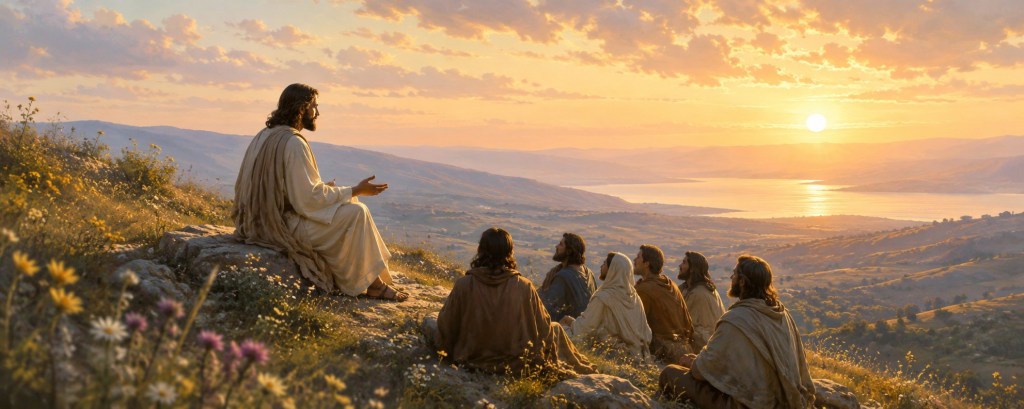
Inspired by: Matthew 5:1-12
Jesus began His greatest sermon in the strangest way. He didn’t start with strength, success, or victory. He started with emptiness.
“Blessed are the poor in spirit: for theirs is the kingdom of heaven.”
I’ve often wondered what the crowd expected to hear that day. Many were looking for a Messiah who would restore Israel’s glory, overthrow oppression, and finally set everything right. Instead, Jesus sat down on a mountainside and began describing the kind of people who belong in His kingdom.
It wasn’t exactly the list anyone would have expected.
If I were writing a list of blessings, I probably would have started somewhere else. Maybe with courage, wisdom, prosperity, or influence. Yet Jesus starts with those who recognize they have nothing to bring to God except their need.
That may be because God’s kingdom operates differently than the kingdoms of this world. The world tells us to believe in ourselves. Jesus invites us to recognize our need of Him. The world admires self-sufficiency. Heaven celebrates dependence upon God.
The Beatitudes are often read as a collection of separate blessings, but I’ve come to see them as something more. They describe a journey. In many ways, they read like a portrait of a soul learning to walk with God.
It begins when a person becomes poor in spirit. For perhaps the first time, they see themselves honestly before God. That realization naturally leads to mourning—not merely over life’s hardships, but over the damage sin has caused in their own heart and in the world around them. Yet Jesus promises that those who mourn will be comforted. God never reveals a wound without also offering healing.
As that healing work continues, something else begins to grow. The person who once defended self at every turn becomes meek. Meekness isn’t weakness. Moses was called meek. Jesus described Himself as meek. Neither lacked strength. Meekness is strength surrendered to God. It is the quiet confidence that comes from trusting Him rather than insisting on our own way.
Then something remarkable happens. The person who once thought they were spiritually satisfied begins to hunger for something more. Jesus says, “Blessed are those who hunger and thirst for righteousness.” Not a casual interest. Not an occasional desire. A hunger. A thirst.
Anyone who has ever been truly thirsty understands the picture. Nothing else matters until that thirst is satisfied. Jesus promises that those who long for righteousness in that way “shall be filled.” What a beautiful promise. God never creates a holy hunger without providing heavenly bread.
As Christ fills the heart, His character begins to flow outward. Mercy appears. Purity grows. Peace follows. What begins as an inward work of grace slowly becomes visible in the way we treat other people. I’ve noticed that the people who are quickest to extend mercy are often those who are most aware of how much mercy they’ve received themselves. It’s difficult to look down on someone when you’ve spent enough time looking up at the cross.
The peacemakers Jesus describes are not simply people who avoid conflict. They are people who carry the spirit of Christ into broken places. They build bridges where others build walls. They seek restoration where others seek victory.
Then the Beatitudes take an unexpected turn. Jesus begins speaking about persecution.
At first glance, it almost seems out of place. Yet perhaps it isn’t. A life that reflects the character of Christ has always been misunderstood by some. The same world that rejected the prophets eventually rejected Jesus Himself. Why should His followers expect a different response?
What amazes me is that Jesus still uses the word “blessed.” Blessed when poor in spirit. Blessed when mourning. Blessed when hungry for righteousness. Blessed when persecuted.
The blessing is not found in the circumstance. It is found in the presence of Christ. That’s why a person can be poor in spirit, mourning, misunderstood, or even persecuted and still be called blessed. A person walking closely with Him possesses something the world cannot give and therefore cannot take away.
The Beatitudes begin and end with the same promise: “theirs is the kingdom of heaven.” The kingdom belongs to the one who first recognizes their need of God, and it still belongs to the one who remains faithful when following Christ becomes costly.
Between those two promises lies the entire Christian journey. It begins with surrender, continues through transformation, and ends in victory. Or perhaps more accurately, it begins with grace, continues by grace, and ends with grace.
Maybe that’s the greatest surprise in all the Beatitudes. Jesus isn’t showing us how to earn a place in His kingdom. He’s showing us what His grace looks like when it takes root, grows, and finally bears fruit in a human heart.
And that, my friend, is a blessing most of us never expected.
If this Fireside Chat warmed your spirit and sparked fresh resolve to live what you believe, fan that flame with Scripture—“Let the word of Christ dwell in you richly” (Colossians 3:16). Pull a little closer to the Light, and carry it into the week ahead.
👉 Sign up for the free FAST Crash Course in Bible Memorization: http://fast.st/cc/21419


Leave a comment